In this guide
- Why is my credit score not showing up?
- Can you have a credit report but no credit score?
- How long does it take for a credit score to appear?
- Why did my credit score disappear?
- What does “credit score unavailable” mean?
- What should you do if your credit score is not showing?
- Should you open several credit cards to get a score faster?
- Does checking your own credit score hurt it?
- Why can one bureau show a score while another does not?
- Can paying off debt make your score unavailable?
- Frequently asked questions
- Bottom line
- Sources and methodology
Quick answer: If your credit score is not showing up, it usually means the scoring model does not have enough recent credit-report information to generate a score, or the app/lender you are checking does not currently have a score available from that bureau. For a FICO Score, FICO says your credit report generally needs at least one account that has been open for six months or more and at least one account reported to the bureau within the past six months. You can also have a credit report but still have no FICO Score. Start by checking your actual credit reports, confirming that your accounts are reporting correctly, and identifying which score model and bureau the service is trying to use.
First separate a missing score from an inaccessible report. This guide covers a scoring model or service that does not show a number. If the bureau cannot release the underlying report or verify your identity, use the credit-report retrieval guide instead. You cannot confirm whether the report meets a model’s criteria merely from an access-error message.
Why is my credit score not showing up?
A credit score is calculated from information in a credit report. If there is not enough eligible or recent information for a particular scoring model, that model may not generate a score.
The Consumer Financial Protection Bureau notes that consumers have many credit scores. Different lenders may use different scoring models, different credit bureaus, and different versions of a model. So one service may show a score while another says no score is available.
1. You do not have enough credit history yet
If you recently opened your first credit account, you may already have a credit report but still not meet the minimum requirements for a FICO Score.
FICO states that, in general, a credit report needs:
- at least one account opened for six months or more;
- at least one account reported to the credit bureau within the past six months; and
- no indication on the report that you are deceased.
One account can satisfy more than one of these requirements. But opening a card last month does not normally produce an immediate FICO Score just because the account appears on your report.
2. Your credit file has become inactive
You can have an older credit history and still lose the ability to generate a current FICO Score if there has been no recently reported account activity.
This can happen after you pay off your last loan, close or stop using your cards, and then go for an extended period without accounts reporting activity.
Your old credit history does not necessarily vanish. The issue is that the scoring model may not have recent enough information to calculate a valid score.
3. Your account is not reporting to that credit bureau
A lender does not necessarily report every account to all three nationwide credit bureaus. If an app uses Experian data but your only account reports to TransUnion, for example, the Experian-based score may be unavailable.
Check your reports separately rather than assuming all three contain the same accounts.
4. The account was opened recently and has not reported yet
Opening an account and seeing it in your banking app does not mean it has already reached your credit reports. Lenders generally report on their own schedules.
If the account is brand new, give the creditor time to furnish the account information. Then check the “date updated” or similar field on the credit report.
If you are waiting for a recent account change, read why your credit report may not be updating.
5. You are checking a different score than the lender uses
The CFPB emphasizes that there is no single universal credit score. You may have multiple FICO Scores, VantageScores, and other scores based on different bureau data.
That means:
- one app can display a VantageScore while another tries to show a FICO Score;
- one lender may use Experian data while another uses Equifax or TransUnion;
- a score can exist for one bureau but not another; and
- the scores can update on different dates.
Before troubleshooting, identify the score model and bureau shown by the service.
Can you have a credit report but no credit score?
Yes.
A credit report is the underlying record of your credit accounts and activity. A credit score is a number calculated from report data using a scoring formula.
You can therefore have a report that contains one or more accounts but still not meet the minimum criteria for a particular score model.
| Situation | Credit report? | Credit score? |
|---|---|---|
| You just opened your first card | Possibly, once the lender reports it | A FICO Score may not be available yet |
| You have older closed accounts but no recent activity | Yes | A current FICO Score may be unavailable |
| Your account reports to only one bureau | May exist at one bureau and not another | Depends on the bureau used for the score |
| You have established, recently reported accounts | Yes | A score is generally more likely to be available |
How long does it take for a credit score to appear?
For a FICO Score, the key minimum is generally an account that has been open for at least six months plus recent reporting within the past six months.
Experian also notes that building a FICO Score from scratch typically takes at least six months. Other scoring models may be able to generate a score sooner, so you should not assume every score follows exactly the same timeline.
If you opened your first credit card two months ago, the fact that you do not yet have a FICO Score is not necessarily an error.
Why did my credit score disappear?
Do not diagnose an inactive file simply because you paid off a loan or stopped making purchases. Record the actual information below for the score that disappeared.
| What to record | Where to check | What it helps distinguish |
|---|---|---|
| Score model, version, bureau, and last available score date | Score details in the app or lender portal | A changed score product versus a missing score from the same product |
| Report request date and whether the report was released | Official bureau report request | A report-access problem versus a scoring-eligibility problem |
| Oldest relevant account’s opening date | Account details on that bureau report | Whether the account-age requirement appears to be met |
| Most recent account reporting date | Last-reported or updated field, not your last purchase receipt | Whether the report contains a recently reported account |
| Any incorrect deceased indication or mismatched identity information | Report details and the bureau’s explanation | An error requiring investigation instead of more spending or new applications |
Use the completed worksheet when contacting the bureau or score provider. It organizes the evidence; it does not guarantee eligibility for every model or prove why an app failed to display a score.
If your score did not disappear but instead changed sharply after paying off a loan, see why a credit score can drop after paying off debt.
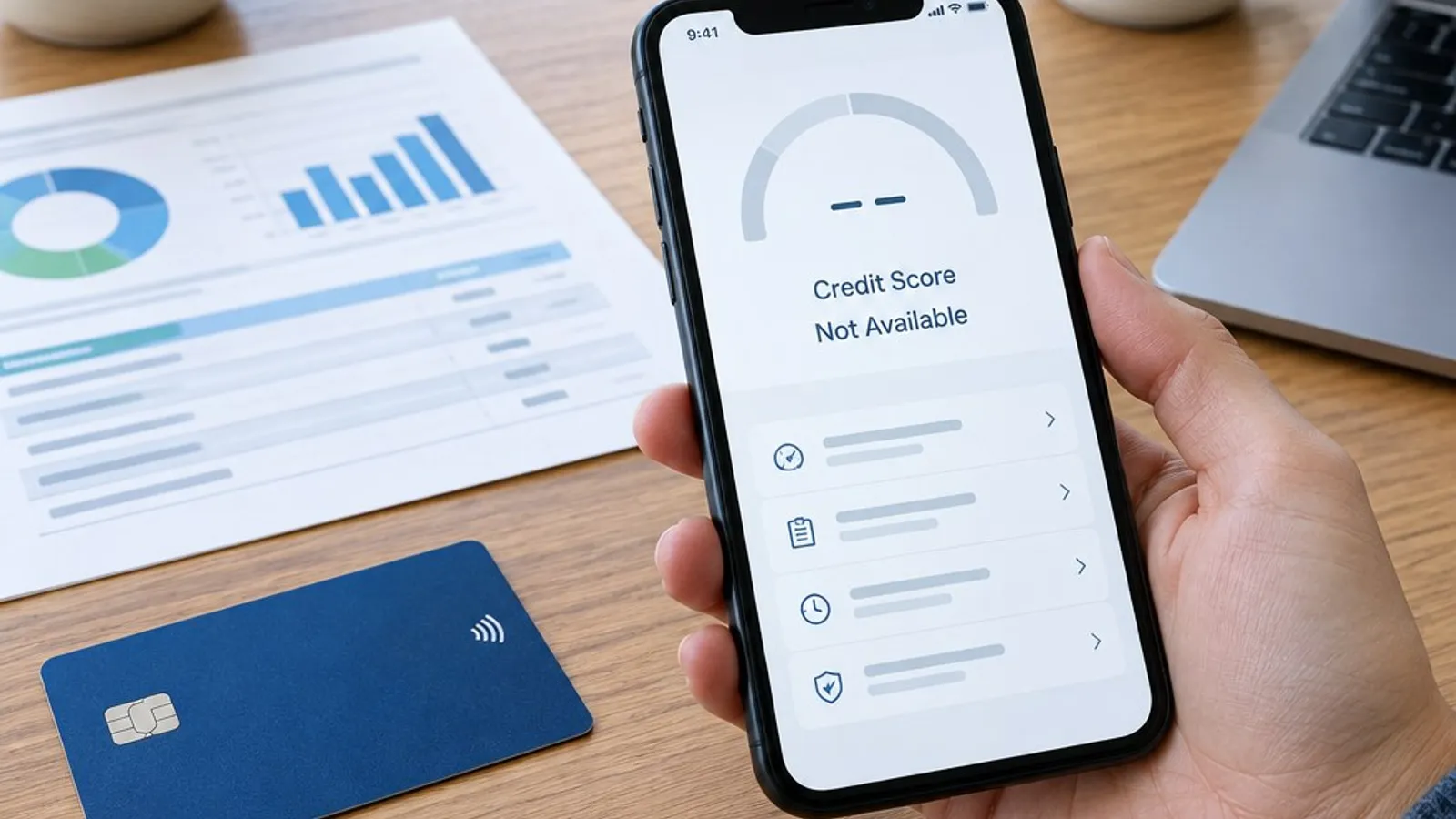
What does “credit score unavailable” mean?
“Unavailable” is not a standardized message that means exactly the same thing on every website or lender portal.
It can mean:
- the scoring model could not generate a score from the available report;
- the bureau has too little information about you;
- the score provider has not refreshed yet;
- the provider is having a temporary technical problem;
- the service is trying to access a bureau file that does not contain enough information; or
- your identity information did not match the bureau file correctly.
Because of that, do not treat the message itself as a diagnosis. Verify what is actually on your reports.
What should you do if your credit score is not showing?
Step 1: Check all three credit reports
Start with the reports, not the score.
You can obtain free reports from AnnualCreditReport.com, the federally authorized source for Equifax, Experian, and TransUnion reports.
Look for:
- which accounts appear on each bureau;
- when each account was opened;
- the most recent reporting date;
- whether an account is open or closed; and
- whether any account or personal information is inaccurate.
Step 2: Confirm which score you are trying to view
Write down the model and bureau if the service identifies them. For example, “FICO Score 8 based on Experian data” is much more useful than simply “my credit score.”
If another app shows a different score, that does not prove either score is wrong. Different scores can use different data and models.
Step 3: If you are new to credit, give the file time to mature
If your first account is less than six months old, there may be nothing to “fix” yet for FICO scoring purposes.
Keep the account in good standing, pay on time, and avoid opening unnecessary accounts solely to force a score to appear.
Step 4: Verify recent reporting before creating new activity
The account’s last-reported date is not the same as your last purchase date. FICO’s minimum requirements refer to an account reported to the bureau within the past six months, alongside an account old enough to meet its age requirement and no deceased indication. They do not say you must buy something every month or pay interest.
Check the last-reported dates on the bureau file used by the score. If an open account has not been updated, ask the issuer whether and when it reports that account. If recent reporting is already present, further spending may not address the reason your score is unavailable; ask the score provider which requirement or access step failed.
When you choose to use an existing card for an ordinary budgeted purchase, keep the payment on time and check whether the issuer actually reports the update. Do not open multiple accounts or take on interest-bearing debt just to troubleshoot a missing score.
Step 5: Correct factual errors
If your report is missing an account that the creditor says it reports, or your identity information is mixed with someone else’s, contact the creditor and bureau.
If you find inaccurate information, follow the formal dispute process. Our guide explains how to dispute errors on your credit report.
Should you open several credit cards to get a score faster?
No. More accounts do not automatically make a score appear faster, and opening several accounts in a short period can create hard inquiries and reduce the average age of your accounts.
If you are starting from scratch, one responsibly managed account can be enough to begin building a credit history. The goal is accurate, consistent payment history over time, not the largest possible number of accounts.
Does checking your own credit score hurt it?
Checking your own credit information generally does not hurt your score. The CFPB explains that inquiries made for your own credit information are not treated like a lender’s hard inquiry for a new application.
So if your score is missing, checking your reports to diagnose the issue is not the same as applying for new credit.
Why can one bureau show a score while another does not?
Because the three credit bureaus can contain different information.
A creditor may report to one or two bureaus but not the third. Even if it reports to all three, the update dates can differ.
For example, if your only qualifying account appears on Experian but not TransUnion, an Experian-based score could exist while a TransUnion-based score is unavailable.
This is another reason to inspect the underlying reports before assuming your “credit score disappeared.”
Can paying off debt make your score unavailable?
It can happen indirectly if paying off debt leaves your file without sufficiently recent reportable account activity for the scoring model.
That is different from a normal score decrease after paying off a loan. If the score is completely unavailable, focus on whether the file meets the model’s minimum scoring requirements.
If the score still exists but fell after an auto payoff, see why a credit score may drop after paying off a car loan.
Frequently asked questions
Why do I have no credit score even though I have a credit card?
If the card is new, you may not yet have enough history for a FICO Score. FICO generally requires at least one account opened for six months or more and recent reporting within the past six months.
Why does Credit Karma show a score but FICO does not?
Different services can use different scoring models and bureau data. A model with different minimum requirements may generate a score even when a FICO Score is not yet available.
Why does Experian say I have no score?
Your Experian report may not contain enough eligible or recent information for the scoring model being used. Check the accounts and update dates on the Experian report rather than relying only on the message.
Can my credit score be zero?
Standard FICO Scores do not use 0 as the bottom of the scoring range. If an app displays 0, a dash, or “N/A,” that can indicate that no score is available rather than that your actual credit score is zero.
How do I get my first FICO Score?
Establish an account that reports to the credit bureaus, keep it in good standing, and allow enough time for the file to meet FICO’s minimum scoring requirements. You do not need to pay interest or carry debt from month to month solely to build a score.
Bottom line
If your credit score is not showing up, do not assume you have “bad credit.” First determine whether you have enough recent credit history for the score model, whether your accounts are reporting to the bureau being used, and whether the provider is showing a FICO Score, VantageScore, or something else.
Check your actual reports, keep legitimate accounts current, and correct factual errors. If you are simply new to credit, time and accurate reporting may be the missing ingredients.
Explore related guides on credit scores.
To understand the entries and statuses behind your score, use our credit report reading checklist before deciding what to do next.
Sources and methodology
- FICO: Minimum requirements for a FICO Score
- CFPB: Understand your credit score
- CFPB: Credit report vs. credit score
- Experian: How long it takes to build credit
- AnnualCreditReport.com
Reviewed against current FICO, CFPB, and Experian consumer guidance. This article is educational and is not individualized financial advice.