In this guide
- Decide what you want the statement to accomplish
- Distinguish hardship context from an unresolved dispute
- Keep sensitive details out of the statement others will read
- Write one short draft before opening the bureau portal
- Check the current limit and removal rules
- Make a review date part of the decision
- Questions to answer before you click save
- Is a consumer statement the same as an “account in dispute” remark?
- How to review or remove an outdated consumer statement
- Sources
A consumer statement on your credit report is a short explanation for people who review the report. It can describe a hardship or an unresolved disagreement, but it does not remove an account, correct the underlying data, or cancel the effect of a late payment on a credit score. Consider adding one only when you have a clear message for a potential human reviewer and are comfortable disclosing that message. If the information itself is wrong, pursue the correction process first. A statement is context, not a substitute for evidence.
Decide what you want the statement to accomplish
Before writing, finish this sentence: “I want a person reviewing my report to understand _____.” If your answer is “that the balance is wrong,” the next action may be an investigation rather than a statement on your report. If your answer is “why several accurate late payments occurred during a temporary hardship,” a short statement may communicate context.
Experian explains the limits of consumer statements: they can open a discussion with a lender, but do not hide negative entries or reduce their scoring impact. Do not assume an automated application decision will change because you wrote an explanation.
| Your situation | Useful route | What to avoid |
|---|---|---|
| A reported fact is inaccurate | Dispute the specific fact with evidence | Using an explanation as the only attempt to correct the record. |
| Accurate late payments followed a temporary hardship | Consider a short, factual hardship explanation | Promising that a statement will raise your score. |
| An investigation did not resolve a disagreement | Review the result and consider a concise dispute statement | Claiming a bureau has confirmed your position when it has not. |
| You suspect identity theft | Use the relevant fraud-recovery process | Treating an ordinary consumer statement as a fraud alert or block. |
Distinguish hardship context from an unresolved dispute
A hardship statement acknowledges what happened and supplies limited context. A dispute statement explains why you disagree with the way something is reported. Combining them carelessly can make your position unclear: “I never paid late, but the payment was late because of illness” communicates two different factual claims.
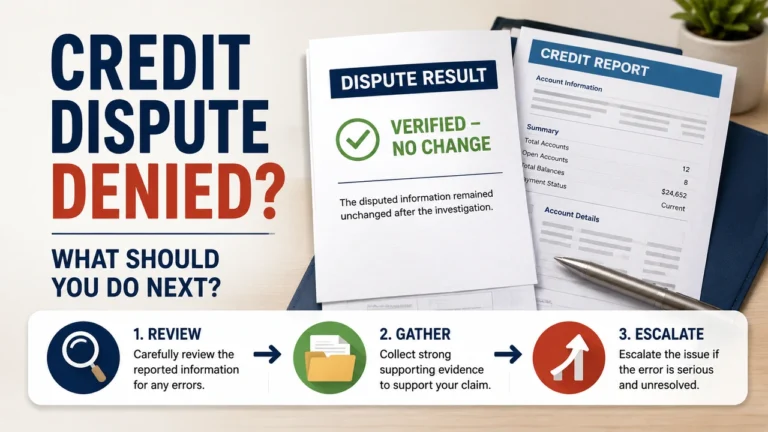
If a dispute was rejected, use our guide to next steps after a denied dispute before deciding that a statement is your only option. Review the evidence and the bureau’s explanation. If the account is accurate and you want the creditor to consider a courtesy adjustment, that is a separate goodwill request, not the same as adding a statement to a report.
Keep sensitive details out of the statement others will read
Your credit report is not a private journal. The statement is intended to be seen by parties who legitimately obtain the report. TransUnion specifically warns that personal or medical information included in a statement can be disclosed to report users. A diagnosis, treatment schedule, child’s name, or full bank account number rarely needs to appear in a brief explanation.
Use the least detail needed to make the point. “A temporary medical hardship interrupted income” communicates a different level of detail from listing treatment and health records. If a lender asks for supporting documentation, discuss its secure submission channel separately. Do not insert confidential evidence into the consumer statement itself.
Write one short draft before opening the bureau portal
Use four components: the issue, the relevant period, the limited context or disagreement, and the current factual status. Leave out threats, speculation about scoring algorithms, and accusations you cannot support. An unemotional statement can be easier for a reviewer to understand than a long account of every frustrating phone call.
Illustrative hardship draft: “A temporary loss of income affected payments on [account or period]. My income situation changed in [month/year], and I brought the account current in [month/year]. I am providing this context for a manual review of my application.”
Use that wording only if every fact is true. If the account is still past due, do not say it is current. If the hardship affected several accounts, check whether the bureau offers an appropriate general statement rather than attaching an inaccurate explanation to a single unrelated account.
Illustrative dispute draft: “I disagree with the reported [specific status] for [account and period]. I submitted [type of evidence] on [date] and requested correction. The investigation has not resolved my disagreement. I can provide the relevant records through a secure channel.”
These are original examples to adapt, not legal forms or guaranteed approval language. Avoid publishing a full account number; follow the bureau’s identification fields for linking the statement to an account.
Check the current limit and removal rules
TransUnion’s current FAQ describes a 100-word statement after an unresolved investigation and a separate online statement workflow allowing up to 1,000 characters. Those are not interchangeable measurements. Follow the instructions in the actual channel you use and keep your draft brief enough to communicate its point without truncation.
Other bureaus can have different procedures for general and account-specific statements. Confirm whether you can choose an expiration date, whether the statement is linked to an account, and how you will edit or remove it later. Do not assume one bureau forwards your chosen wording to every other bureau.
The OCC’s consumer guidance also discusses adding a statement after an unresolved dispute. Treat that as a right to present your position, not a determination that the disputed information must be deleted.
Example: adding or removing a statement at TransUnion
Its official FAQ describes this online route:
- Sign in to the TransUnion Service Center.
- Open the dispute area and find the consumer-statement management option.
- Choose provided wording or enter your own text within the displayed character limit.
- Set an expiration date and save. Use the same statement-management area if you later want to remove it.
Keep a copy of what you submitted and verify the wording on the resulting report.
Make a review date part of the decision
An illustrative problem: a person explains an old late-payment episode in a general statement. Later, the related information is no longer on the report, but the explanation is still visible. It may now raise a question that the current report would not otherwise raise. Review the statement when the account is corrected, removed, or no longer relevant.
Record the bureau, exact wording, date added, scope, expiration setting, and a reminder to review it. After saving, obtain the report and check the actual text using our credit report reading checklist. A confirmation screen alone does not tell you how a later report presents it.
Questions to answer before you click save
- Is every statement accurate and consistent with my records?
- Have I pursued correction of any factual error?
- Does the text reveal unnecessary personal or medical details?
- Do I understand that it will not change my score by itself?
- Have I saved the wording and the removal instructions?
If you are in an active loan application, ask the lender what documentation its review process actually needs. Our adverse action notice guide can help you distinguish the lender’s stated reasons from assumptions about what a statement might fix.
Is a consumer statement the same as an “account in dispute” remark?
No. A statement you submitted and a dispute notation reported by a creditor can have different sources. Experian distinguishes these two situations: you can request removal of your personal statement, while a creditor may report an account as disputed during its investigation.
- Your own statement: identify the opening words and ask the bureau how to remove or replace it.
- A creditor’s dispute remark: ask the creditor whether its investigation is complete and why it is still reporting that status.
Before acting, copy the exact wording and establish who supplied it. Removing your explanation does not establish that a separate creditor notation changed or that the underlying error was corrected. If a lender raises the issue during an application, ask which specific remark it means.
For the creditor-supplied notation, our account-in-dispute remark checklist explains how to distinguish an open review from a completed investigation and request correction of an inaccurate status.
How to review or remove an outdated consumer statement
Review the statement itself after an account correction or a change in circumstances. A general explanation can outlast the event it describes. Experian’s guidance explains why statements deserve periodic review instead of being left on a file indefinitely.
First save the exact wording and identify whether it is general or attached to a specific account. Then use that bureau’s current procedure to request revision or removal. Treat this as a statement-management request; do not accidentally request deletion of a legitimate account merely because you want its accompanying explanation removed.
Illustrative request: “Please remove the consumer statement beginning [opening words], shown on my report dated [date]. I am requesting removal of that statement, not a change to the underlying account information. Please confirm how I can verify the updated report.”
Check each bureau separately. Keep the replacement wording, if any, as concise and privacy-conscious as the original draft.
Explore related guides on credit reports and disputes.
If a credit report contains inaccurate information, follow our step-by-step guide to disputing credit report errors for evidence, deadlines, and follow-up.
Sources
- Experian: limits of consumer statements
- TransUnion: statements and dispute procedures
- OCC: statements after an unresolved dispute
Updated October 6, 2026. Product terms and submission procedures can change; confirm the current instructions with the relevant organization.
Claire Bennett is the site’s editorial name, as explained on our author page.
Educational information only, not individualized financial or legal advice. Examples are illustrative; results depend on your circumstances.
Photo: Jodie Cook / Unsplash. Illustrative photograph; not a customer story or testimonial.