In this guide
- What happens when you max out a credit card?
- What “maxed out” means in practice
- What can happen right away
- How a maxed-out card can affect your credit
- Illustrative $1,000-limit calendar
- What to do when you are at or near the limit
- When to call your card issuer
- Take the next practical step today
- Frequently asked questions
- Your next step
- Sources
What happens when you max out a credit card?
If you max out a credit card, your available credit falls to zero or close to it. New purchases may be declined, interest can keep adding to the balance, and your minimum payment may increase. A high reported balance can also raise both that card’s utilization rate and your overall revolving credit utilization, which may affect credit scores. Maxing out a card is not automatically a late payment or a permanent credit-score problem, but it can become costly quickly if you cannot make at least the required minimum by the due date.
The most important next step is to stop adding charges, protect essentials such as housing, food, and utilities, and make a realistic repayment plan before the next due date and statement reporting cycle.
What “maxed out” means in practice
A card is generally maxed out when its balance reaches its credit limit. For example, a card with a $1,000 credit limit is maxed out at a $1,000 balance. In real life, the situation can be less neat because interest, fees, pending purchases, refunds, or a temporary authorization may affect the amount of credit available.
Your card issuer may decline a charge once you have no available credit. Some issuers may allow a transaction that slightly exceeds the limit, depending on the account terms and the transaction. Do not count on that happening. An over-limit charge can still leave you with a higher balance and less room to handle an emergency.
It also helps to separate three numbers that can look similar in an app:
- Current balance: What you currently owe, including posted transactions.
- Available credit: Your remaining borrowing room after posted and sometimes pending activity.
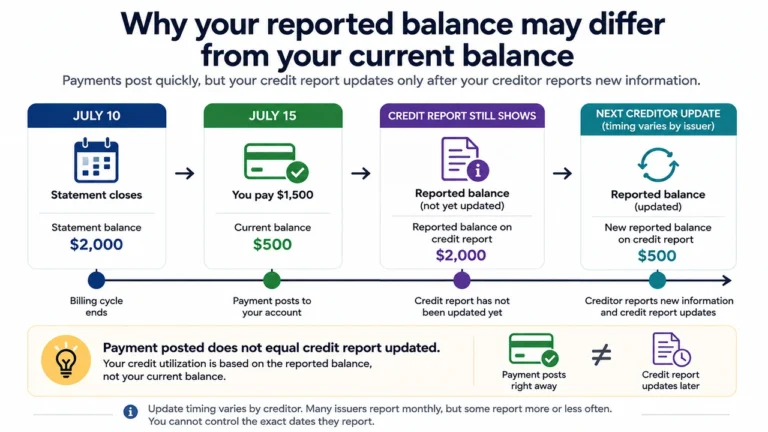
- Statement balance: The balance shown when the billing cycle closes, which is often important for payment planning and may be the balance later reported to credit bureaus.
A card can show a lower balance today than the balance that was reported earlier in the month. Likewise, you can have a high current balance that has not yet appeared on a credit report. For a fuller explanation, see credit card statement date vs. due date.
What can happen right away
Maxing out a card changes how usable the account is immediately. It can also make an already tight budget more fragile, especially when recurring subscriptions, automatic bill payments, or emergency expenses are tied to that card.
Purchases may be declined
A merchant may not be able to complete a purchase when no credit remains. Automatic payments can fail too, which can create separate late-payment problems with service providers.
Interest keeps accruing
If you carry a balance, interest can continue to add to what you owe under your card agreement. A payment may free credit, but it does not erase accumulated interest.
The minimum payment can rise
Minimum-payment formulas vary by issuer, but a larger balance can mean a larger required payment. Review your statement rather than estimating the amount.
How a maxed-out card can affect your credit
Credit utilization describes how much revolving credit you are using compared with your available credit. A $900 balance on a $1,000 limit represents 90% utilization on that card. If your other cards have unused limits, your overall utilization may be lower, but the near-maxed card can still be a concern in credit scoring.
There is no universal utilization percentage where credit scores suddenly fall off a cliff. Different scoring models and credit files can react differently. Still, a reported balance near a card’s limit generally signals heavier use of available revolving credit than a lower reported balance.
Utilization is based on information in your credit reports, not necessarily the balance visible in your banking app at this moment. Many issuers report account information around their own reporting cycle, often near the statement closing date, but practices vary. Paying down a balance before it is reported may lower the reported amount; paying after reporting may not be reflected until a later update.
Learn more about the concept in What is a good credit utilization ratio?. The Consumer Financial Protection Bureau also notes that paying balances in full each month can help avoid interest and may keep reported balances lower, although credit reporting timing still matters.
High utilization is different from late payment history. A maxed-out card can affect utilization even when every payment is on time. Missing the minimum payment is a separate and more serious issue because it can lead to fees, loss of promotional terms where applicable, and delinquency reporting if the account remains unpaid.
Illustrative $1,000-limit calendar
Illustrative scenario: Assume a card has a $1,000 limit, a statement closing date on the 20th, and a payment due date on the 15th of the following month. Actual issuer dates, interest calculations, and reporting practices differ.
- May 5: The card balance is $700, leaving $300 available.
- May 16: A $250 repair charge posts. The balance becomes $950, leaving $50 available.
- May 19: A $50 grocery purchase posts. The balance reaches $1,000 and available credit is $0.
- May 20: The billing cycle closes with a $1,000 statement balance. That is the balance shown on the new statement and may be the amount the issuer reports around its reporting cycle.
- May 28: The cardholder pays $300. The current balance falls, and available credit may increase after the payment is processed, but the previously reported balance may remain on the report until a future update.
- June 15: The cardholder checks the remaining minimum due. The May 28 payment normally counts toward the minimum on the May 20 statement if it cleared and was credited for that cycle. Pay any remaining required amount by June 15; do not assume a second minimum payment is due after it has already been satisfied.
This example shows why statement dates and due dates serve different jobs. Paying before the due date helps prevent lateness. Paying before a reporting or statement cycle may also affect the balance that gets reported, but it is not a guarantee because issuer practices vary.
What to do when you are at or near the limit
Do not let the pressure of a maxed-out card push you into choices that worsen your basic financial stability. Start with cash-flow triage, then address the card balance methodically.
Damage-control priority list
- Protect housing, food, necessary medication, transportation to work, and essential utilities.
- Review every bill due before your next paycheck, including automatic charges connected to the card.
- Make at least the required minimum payment on the card by the due date if your budget allows after essentials.
- Stop optional card spending and remove the card from saved payment methods temporarily.
- Direct any extra amount toward the maxed-out balance after required bills are covered.
- Contact the issuer early if you expect trouble making the minimum payment.
A quick repayment worksheet
- Card limit: ________
- Current balance: ________
- Available credit: ________
- Statement closing date: ________
- Payment due date: ________
- Required minimum payment: ________
- Amount available beyond essentials this pay period: ________
- One expense to pause or reduce: ________
If you have several accounts past due or expect that to happen, use a focused plan rather than splitting limited money randomly. This guide on what to do when multiple accounts are past due can help you organize the next steps.
When to call your card issuer
Call before you miss a payment if a job loss, medical issue, reduced hours, or other hardship makes repayment unrealistic. Explain the situation plainly, ask what assistance is available, and get any proposed terms in writing or through your secure account messages when possible.
Depending on the issuer and your account, options may include a temporary payment arrangement, a reduced payment, a lower interest rate, a waived fee, or account restrictions while you repay. These are not guaranteed, and a hardship arrangement may affect how you use the account. Ask how the arrangement affects your minimum payment, interest rate, ability to make new purchases, account status, and credit reporting.
For more context before that conversation, review how a credit card hardship program can affect credit. Avoid treating a new credit card as the default solution. Opening another account can add complexity, and transferring a problem without changing the budget may only delay it.
Take the next practical step today
Check your statement balance, due date, and available credit. Then make a plan that covers essentials and prevents a missed required payment.
Frequently asked questions
Can a maxed-out credit card hurt my credit score?
It can. A high reported balance can increase utilization on that card and across your revolving accounts. The exact effect depends on the scoring model and the rest of your credit report. Lowering the reported balance may help, but no specific score change can be promised.
Will my card be closed if I max it out?
Maxing out a card does not automatically mean it will be closed. However, issuers may review accounts, reduce limits, restrict use, or make other decisions under their account terms. Paying on time and reducing the balance is generally more helpful than ignoring the account.
Is it better to pay before the statement date or the due date?
Both dates matter for different reasons. Paying by the due date helps you avoid a late payment. Paying before the statement closes or before the issuer reports can reduce the balance that may appear on your credit report. Check which statement an early payment was credited toward, then pay any remaining required minimum by its due date. You do not need to pay the same minimum twice if it has already been satisfied.
What if my payment posts on the due date?
Check the issuer’s cutoff time and payment rules. The CFPB explains that a payment is generally timely when the issuer receives it by the stated deadline on the due date, but details can depend on the payment method and account terms. Save confirmation numbers and screenshots for online payments.
Your next step
Maxing out a credit card can leave you without borrowing room, increase interest costs, raise your required minimum payment, and increase reported utilization. It does not automatically mean you are late, but missing the minimum payment can add a separate problem. Focus first on essentials, make the required payment when possible, stop new charges, and contact the issuer early if hardship is likely. A clear plan is more useful than trying to solve the problem with more borrowing.
Explore related guides on credit cards and utilization.
For the balance-to-limit calculation behind these changes, see our guide to credit utilization and credit scores.
Sources
Sources checked October 7, 2026.
- myFICO: Amount of debt
- Consumer Financial Protection Bureau: Paying off a credit card balance every month
- Consumer Financial Protection Bureau: When a credit card payment is considered late
- Consumer Financial Protection Bureau: Credit card consumer tools
Claire Bennett is an editorial name, as explained on the author page. No independent expert review is claimed.
Educational disclaimer: This content is for general educational purposes and is not financial, legal, credit, or tax advice. Card agreements, issuer practices, and individual credit reports vary. Consider contacting your issuer or a qualified professional for guidance specific to your situation.