In this guide
- How often is a credit report updated?
- Credit report update checker
- Why can your credit report change several times in one month?
- Do Experian, Equifax, and TransUnion update at the same time?
- How long after a payment does a credit report update?
- Credit report update vs. credit score update
- How do you find the last update date?
- What if your credit report has not updated after a normal reporting cycle?
- Frequently asked questions
- Bottom line
- Sources
- Financial disclaimer
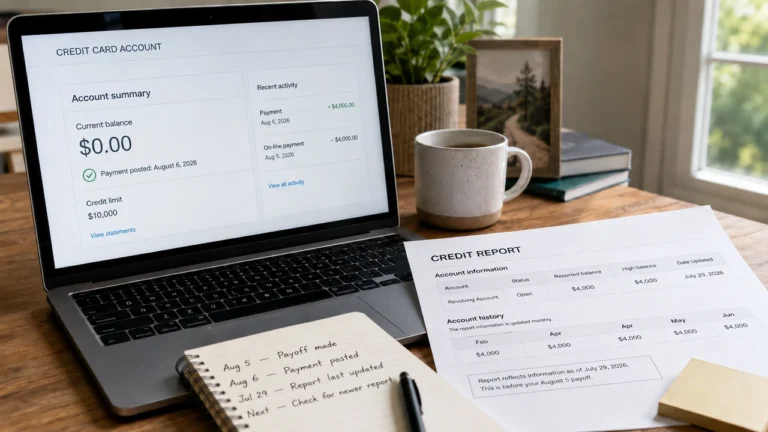
How often do credit reports update? There is no single update day. Lenders and other data furnishers typically send account information to the credit bureaus about once a month, but each company uses its own schedule. Because different accounts can report on different days, your Experian, Equifax, or TransUnion report can change multiple times during a month.
A payment showing in your bank or card app does not mean the same balance has already reached your credit report. To check a specific account, compare the reported balance, account status, and Date Updated on the credit report with your lender’s current records.
How often is a credit report updated?
TransUnion explains that lenders tend to provide updates to credit reporting agencies about once a month and that there is no standard day when every report updates. Experian likewise says lenders and other data reporters typically update account information monthly on their own schedules.
That means a credit report is not refreshed as one complete file on the first, fifteenth, or last day of every month. Instead, individual accounts can change as new information arrives.
| What can update? | Typical pattern | What to check |
|---|---|---|
| Credit card balance | Often around the issuer’s monthly reporting cycle | Reported balance, credit limit, Date Updated |
| Loan balance or payoff | Often after the lender sends its next account update | Current balance, paid/closed status, Date Updated |
| Payment history | Updated when the creditor furnishes newer account information | Month-by-month payment status |
| New account | After the lender begins furnishing it | Open date, lender name, account status |
| Hard inquiry | Can appear after a credit application | Inquiry date and company name |
| Dispute correction | After the investigation and report update | The exact field that was disputed |
Sources: TransUnion on how credit reporting agencies update information and Experian on credit-report update timing.
Credit report update checker
Use this quick check when you made a payment or account change but still see old information. It does not force an update or decide that information is inaccurate; it helps you identify what to verify next.
Has the new information reached your credit report?
Why can your credit report change several times in one month?
Your accounts do not all share one reporting calendar. A card issuer might furnish a balance during one week while an auto lender reports later. If you have several accounts, your report can therefore receive separate updates throughout the month.
TransUnion notes that lenders do not all provide updates on the same day, and even different accounts with the same lender can update on different dates. That is why one account can look current while another still shows the previous month’s information.
Do Experian, Equifax, and TransUnion update at the same time?
Not necessarily. A lender may report to all three nationwide credit reporting companies, only some of them, or send updates in a way that results in different processing dates. Your reports can therefore show different balances or update dates temporarily.
Do not assume a difference between bureaus is automatically an error. First compare:
- the lender or furnisher name;
- the account identifier;
- the balance and status;
- the date each bureau says the account was updated; and
- whether that lender reports the account to each bureau.
How long after a payment does a credit report update?
There is no universal deadline for an ordinary balance update. A payment can post to your lender first and appear on your credit report later after the lender furnishes account data and the bureau processes it.
TransUnion says many lenders send updates every 30 days, though timing can extend to around 45 days and some companies report more frequently. Experian similarly describes monthly reporting schedules that vary by creditor.
If you specifically paid off a credit card, use our credit-card payoff reporting timeline. If the report appears to be stuck on old account information, use why a credit report may not be updating.
Credit report update vs. credit score update
A credit report and a credit score are different things. Your report contains account data. A score is calculated from report data using a scoring model.
So the sequence can look like this:
- You make a payment.
- The lender posts the payment internally.
- The lender furnishes updated account data.
- The credit bureau updates the report.
- A score is later calculated using that newer report.
This is why a payment can be visible in your banking app while an older balance still appears in a credit report, and why a report can update before the score displayed in a particular service refreshes.
For score timing, use how often your credit score updates.
How do you find the last update date?
Open the full account entry on the relevant credit report and look for wording such as Date Updated, Date Reported, or similar account-reporting information. Labels vary by bureau and report format.
Compare that date with the event you expected to appear:
- payment date;
- payoff date;
- account closure date;
- settlement completion date;
- dispute result date; or
- credit limit change.
If the report’s account update predates your payment, the old balance may simply be an older snapshot. If the account was updated after your payment but still reports a factual balance or status that conflicts with your records, investigate the possible error.
What if your credit report has not updated after a normal reporting cycle?
After a student loan payment pause, compare the reported status with the servicer’s approval dates. The deferment and forbearance credit guide explains what to verify when relief is pending, approved, or ending.
- Confirm the change with the lender. Make sure the payment cleared or the account change was completed.
- Check all three reports. One bureau may already have newer information.
- Record the Date Updated. Do not rely only on the current score or a monitoring alert.
- Ask the furnisher when it last reported the account. This can distinguish an old snapshot from a newer but inaccurate record.
- Dispute only a factual error. If newer information is still wrong, document the exact field and use the appropriate dispute process.
Use AnnualCreditReport.com, the federally authorized source for reports from Equifax, Experian, and TransUnion. For a step-by-step review, see how to read your credit report.
Frequently asked questions
Do credit reports update every 30 days?
Many lenders report about once a month, but there is no single 30-day update date for your entire credit report. Each lender can use a different schedule.
Can a credit report update more than once a month?
Yes. If multiple lenders furnish information on different days, the report can receive several account updates during the month.
Why did one credit bureau update before another?
Lenders may furnish to the bureaus on different schedules, and the bureaus may receive or process the information at different times.
Does checking your credit report make it update?
No. Checking your own report lets you see the information already in the file; it does not force lenders to send a new account update.
When will an updated report affect my credit score?
A score must be calculated from the newer report data before the change can be reflected. The score provider’s refresh schedule can be separate from the lender’s reporting schedule.
Bottom line
Credit reports do not have one universal monthly refresh date. Lenders commonly furnish account updates about once a month on different schedules, so your reports can change multiple times during a month. Use each account’s reporting date to determine whether you are looking at an old snapshot or newer information that may need correction.
Explore related guides on credit reports and disputes.
Sources
- TransUnion — How credit reporting agencies update information
- TransUnion — How often credit reports and scores update
- Experian — How often a credit report is updated
- AnnualCreditReport.com — Federally authorized free credit reports
Financial disclaimer
This article provides general U.S. consumer-credit education. It does not predict a credit-score change or provide individualized financial or legal advice.