In this guide
- Pause the conversation without losing the record
- Use independent contact details
- Separate identity verification from handing over financial access
- Review the validation information
- Recognize pressure tactics without jumping to conclusions
- Illustrative scenario: the caller knows an old account
- A short script for the first contact
- Check your reports, but understand their limits
- Keep one clear outcome for the next step
- Sources
Quick answer: Before paying an unfamiliar collector or sharing sensitive information, verify the company independently and review its validation information. Ask for the collector’s name, business address, telephone number, and relevant licensing details, then check them through sources other than the unexpected message. A caller knowing your name or part of an account number does not establish legitimacy. At the same time, an unfamiliar company name does not prove fraud: debts can be assigned or sold, and the identity of the collector and the accuracy of its claim need separate checks.
Pause the conversation without losing the record
An unexpected demand can create pressure to solve everything immediately. Your first task is narrower: collect enough information to verify the contact without authorizing a payment or revealing bank credentials.
Write down the date, caller’s claimed name, company, callback number, creditor, amount, and any reference number provided. Save messages and letters. You do not need to decide on the first call whether the entire claim is correct.
The CFPB lists identifying information you can request from a collector and suggests checking with your state attorney general or regulator. Ask about a professional license where your state requires one; do not assume every state has the same licensing system.
Use independent contact details
Find the company’s official contact information independently. A link supplied by the caller can lead back to the caller, and a professional-looking website alone is not verification. Compare the claimed company, address, and contact details with reliable records.
If you recognize the original creditor, use a phone number from an existing statement or its verified website to ask who is authorized to collect. The CFPB recommends checking with the creditor when the debt may be real but the caller is questionable.
Our guide to paying the collector or original creditor covers the later payment-recipient decision. First establish who is involved and what the records say; do not send money merely because one party speaks more confidently.
Separate identity verification from handing over financial access
A legitimate collector may need to confirm that it is speaking with the right person before discussing private debt details. An identity question is therefore not automatically proof of a scam. You can ask what alternative verification method is available and choose a verified channel.
Do not provide a full Social Security number, card details, or bank information to an unverified contact. Do not give someone your online-banking password or a sign-in code so they can “confirm” the debt. The purpose is to establish identity and review a claim, not to give the caller control of an account.
Even when the company is real, confirm that the person contacting you actually represents it. An impersonator can use a legitimate company’s name. Reaching the company through independently verified details helps separate those two questions.
Review the validation information
Once you have verified the collector, our guide to writing and sending a debt validation letter helps you turn a specific concern into a documented request.
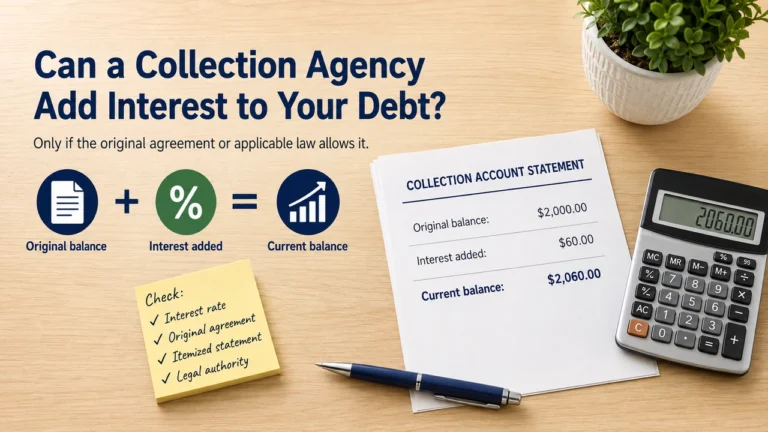
The CFPB explains the information generally required in a collection validation notice, including the creditor, amount, itemization, and response instructions. Compare that information with your own records. If interest or fees increased the amount, check whether the collector has a contractual or legal basis for the added charge. Note the dispute deadline rather than putting the notice aside while making unrelated calls.
| Check | Useful follow-up |
|---|---|
| The creditor name is unfamiliar. | Ask which original account or business the claim concerns. |
| The balance does not match your records. | Compare the itemization, dates, payments, credits, and stated charges. |
| You believe you already paid. | Locate the payment and resolution records before sending copies through a verified channel. |
| The account is not yours. | Investigate identity theft or a mistaken identity and use the appropriate dispute process. |
| The sender refuses basic company details. | Stop sharing information and verify independently. |
Recognize pressure tactics without jumping to conclusions
Threats, refusal to identify the company, and demands for immediate sensitive information are warning signs. They can indicate a scam or improper behavior by a real collector. Either way, keep the evidence and verify the contact.
A demand that you pay instantly to avoid arrest deserves particular caution. The CFPB explains that collectors cannot threaten arrest merely for unpaid debt, while also noting that ignoring certain court orders can have serious consequences. Do not turn “this threat is suspicious” into “all court paperwork can be ignored.”
If a document appears to come from a court, verify it through that court’s independently located contact information and address any response deadline promptly. Do not let the caller’s version of the deadline substitute for the actual document.
Illustrative scenario: the caller knows an old account
You receive a call naming a card you once had and quoting a plausible balance. The caller also knows your former address. That information makes the claim worth investigating, but it does not establish the caller’s authority.
You ask for the company details and written validation information, then contact the known creditor through a verified number. You compare the collector identified by the creditor with the company in the notice. Next you compare the amount with your payment records.
Those checks can produce different outcomes: a verified collector with a correct claim, a verified company with a disputed amount, or an unverified contact using real account information. Each requires a different response; no single detail from the initial call settles all three questions.
A short script for the first contact
Please provide your name, company name, mailing address, telephone number, and the required information about the debt. I will verify the company independently and review the notice before discussing payment or providing sensitive financial information.
Keep the conversation focused on obtaining information. If you believe the contact is fraudulent, stop engaging through that channel and preserve the records for a complaint or report. Avoid arguing about every detail while under pressure.
Check your reports, but understand their limits
Use our free-credit-report instructions to review unfamiliar accounts. A report can provide useful account information, but a debt’s absence from a report does not by itself prove that it does not exist or that a caller is legitimate.
If someone else’s information appears in your file, our mixed-credit-file guide explains that separate problem. If identifying information has been misused, use IdentityTheft.gov for recovery guidance and consider our three-bureau freeze instructions for limiting new-credit access.
Keep one clear outcome for the next step
End your review with a specific status: company not yet verified, company verified but debt disputed, payment recipient confirmed, or identity-theft investigation needed. Record the next action and any actual deadline.
Verification is not an agreement to pay an unexamined claim. It is the foundation for deciding how to respond accurately, without surrendering sensitive information to whoever contacted you first.
By Claire Bennett, the editorial name used by the site’s founder and editor. Factual guidance checked against the linked official sources. Photo: Beatriz Pérez Moya / Unsplash.
If a verified collector reaches you at work, treat the contact instructions separately from verifying the account. See when a debt collector can contact your employer and how to stop workplace calls for the privacy rules and a written request.
Explore related guides on collections.
Sources
- CFPB: verifying debt collectors
- CFPB: personal information and collectors
- CFPB: debt validation information
- CFPB: unpaid debt and arrest threats
Sources checked October 4, 2026. General educational information for U.S. readers; not individualized financial or legal advice. Examples are illustrative and do not predict credit scores or lending decisions.