In this guide
- Quick example
- What credit utilization ratio should you aim for?
- Is 30% credit utilization actually good?
- Is under 10% credit utilization better than under 30%?
- Is 0% credit utilization good?
- What is a good balance for your credit limit?
- How much should you pay to reach a target utilization?
- Overall vs. per-card credit utilization: why both matter
- What should you do based on your utilization?
- Which balance counts toward your credit utilization?
- Will lowering credit utilization increase your credit score?
- What if utilization is low but your score is not increasing?
- Frequently asked questions
- Related guides
- Sources and editorial information
A good credit utilization ratio is generally below 30%, while below 10% is a stronger target when you want to keep your reported balances especially low. Neither number guarantees a credit score: 30% is a guideline, not a scoring cliff. Check both your combined utilization and each card. You do not need to carry debt or pay interest to build credit.
The CFPB advises keeping credit use at no more than 30%; Experian recommends single digits for people focused on excellent scores. These are practical benchmarks, not promises about your score.
For example, on a $1,000 limit, $300 is exactly 30%, $100 is exactly 10%, and $90 is 9%. If your goal is below 10%, the reported balance must be less than $100.
Need the basics? See what credit utilization means and how to calculate it. This guide focuses on choosing a target and translating it into dollars.
Quick example
Suppose your total revolving credit limits are $10,000 and your reported credit card balances total $2,400. Your overall utilization is:
$2,400 ÷ $10,000 × 100 = 24%
If your target is 10%, the reported balance associated with that target is $1,000. To move from $2,400 to $1,000, reported balances would need to fall by $1,400. This calculation tells you the balance needed to reach the target; it does not predict how many credit-score points you would gain.
What credit utilization ratio should you aim for?
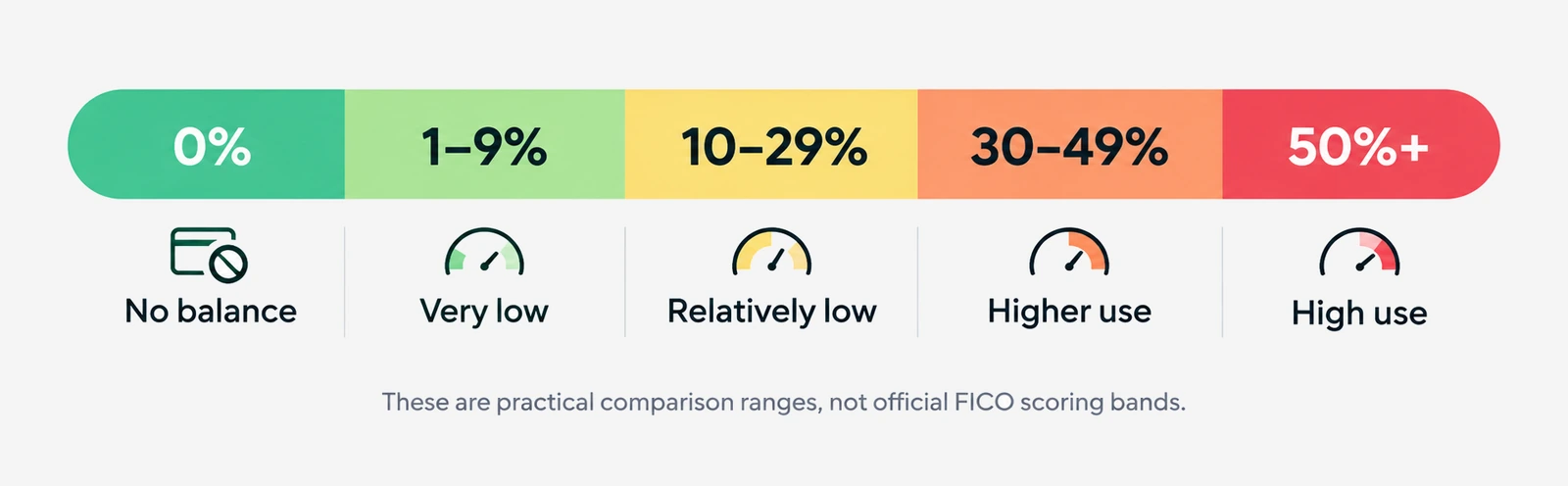
If you want to optimize your credit profile, single-digit reported utilization can be a reasonable target. There is no percentage that guarantees a particular score, and 30% is not a hard dividing line between “good” and “bad.” Use the ranges below as practical comparison points rather than official FICO scoring bands.
| Reported utilization | How to interpret it | What to consider |
|---|---|---|
| 0% | No revolving balance is currently being reported. | You do not need to carry debt or pay interest just to create utilization. |
| 1%–9% | Very low utilization. | A reasonable range when the goal is to keep reported utilization especially low. |
| 10%–29% | Relatively low utilization. | Below the commonly cited 30% guideline, although lower may still be more favorable. |
| 30%–49% | A larger share of available revolving credit is being used. | Consider whether reducing reported balances fits your budget. |
| 50%–74% | High utilization. | Check both overall utilization and each individual card. |
| 75%–99% | Very high utilization. | One or more cards may be close to their limits. |
| 100% or more | A reported balance may be at or above the stated limit. | Check the reported balance and limit for accuracy. |
Practical takeaway: do not aim for 30% as if it were the goal. If your finances allow it and you want to keep reported utilization low, single digits can be a reasonable benchmark. Do not miss essential bills, drain emergency savings, or borrow expensive money merely to hit a utilization target.
Is 40% credit utilization bad?
A 40% reported utilization ratio is higher than the commonly cited 30% guideline and falls in the 30%–49% range above. It does not guarantee a specific score drop, but lower reported revolving utilization is generally more favorable than using a larger share of your available credit. Check both your overall utilization and each individual card before deciding what to pay down.
Is 30% credit utilization actually good?
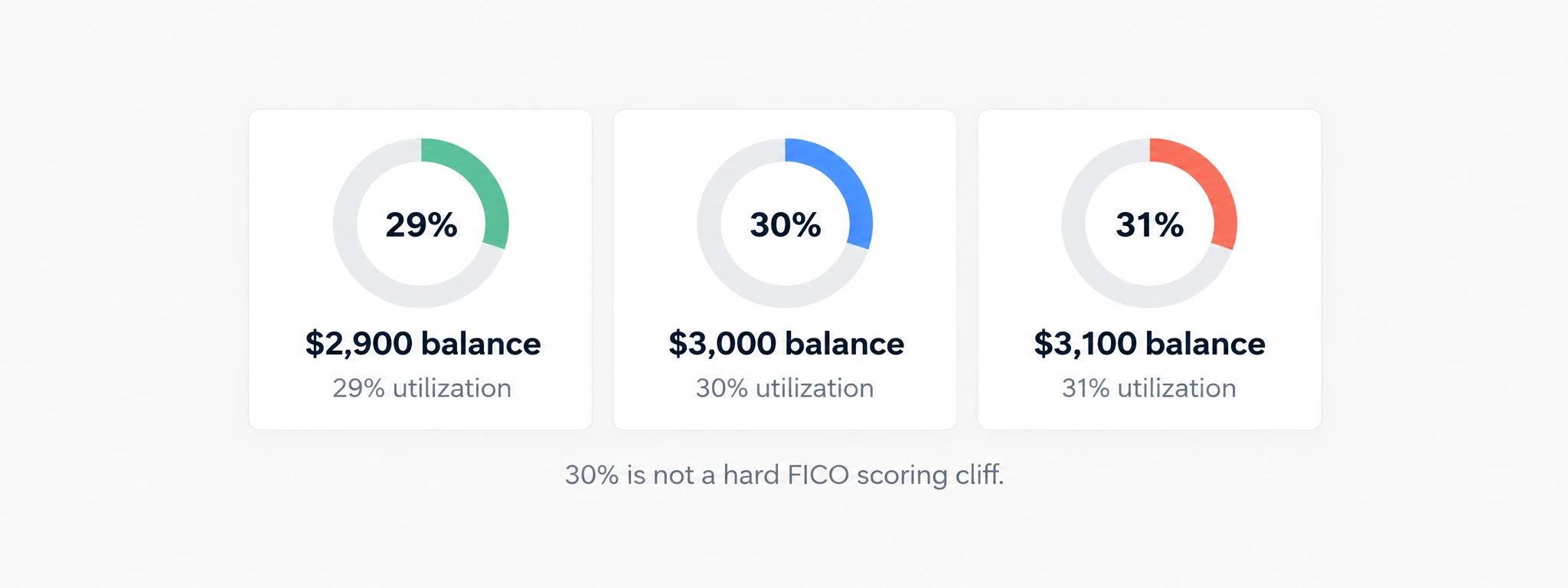
Thirty percent is not a target you need to hit, and it is not a scoring cliff. FICO explains that its data does not support a universal score drop at 30%. The effect depends on the rest of your credit profile.
That means 29% is not automatically good while 30% or 31% is automatically bad. Lower utilization can still be more favorable below 30%, and moving above 30% does not let anyone predict an exact score loss.
| Reported balance on $10,000 in limits | Utilization | How to read it |
|---|---|---|
| $2,900 | 29% | Below the common 30% guideline |
| $3,000 | 30% | Exactly 30%, but not an official FICO cutoff |
| $3,100 | 31% | Above 30%, without a universal fixed score penalty |
Is under 10% credit utilization better than under 30%?
Generally, lower reported utilization is better, so staying below 10% can be more favorable than simply staying below 30%. FICO says keeping utilization below 10%, together with consistently paying bills on time, can help build and maintain a good FICO Score. Experian also reports that people with stronger score profiles tend to have lower utilization.
That does not make 10%, 9%, 5%, or 1% a guaranteed scoring threshold. A consumer with 8% utilization can still have a lower score because of late payments or other information, while someone at a higher ratio may have a different overall profile.
| Utilization | Balance on $10,000 in limits | Interpretation |
|---|---|---|
| 30% | $3,000 | Common guideline, not a hard cutoff |
| 10% | $1,000 | Low utilization |
| 9% | $900 | Single-digit utilization |
| 5% | $500 | Lower single-digit utilization |
If reaching single digits fits your budget, it can be a reasonable target. If doing so would create financial stress, do not treat it as a requirement.
Is 0% credit utilization good?
Zero percent utilization is not inherently bad, and you do not need to carry debt to avoid it. FICO says a low reported balance can sometimes score more favorably than no revolving usage. That does not mean everyone should report exactly 1%.
A reported balance is not the same as carrying debt from month to month. A small balance can appear on your credit report and still be paid in full by the due date. There is no reason to intentionally pay interest merely to manufacture utilization.
| Reported balance on a $5,000 limit | Utilization | What it means |
|---|---|---|
| $0 | 0% | No revolving balance is currently being reported |
| $50 | 1% | A small amount of revolving credit use is reported |
| $500 | 10% | Low utilization |
What is a good balance for your credit limit?
Use your total credit limit, not the remaining available credit shown in your app. These dollar amounts work for one card or for combined limits, but check each card separately too.
| Credit limit | Exactly 30% | Exactly 10% | 9% example |
|---|---|---|---|
| $300 | $90 | $30 | $27 |
| $500 | $150 | $50 | $45 |
| $1,000 | $300 | $100 | $90 |
| $2,000 | $600 | $200 | $180 |
| $5,000 | $1,500 | $500 | $450 |
| $10,000 | $3,000 | $1,000 | $900 |
Exactly 10% is not below 10%. On a $500 limit, a $50 balance equals 10%; $45 equals 9%. The 9% column is a convenient arithmetic example, not a special FICO cutoff. Allow for any new charges, interest, or fees before the issuer reports.
Small-limit example: A $220 balance on a $500 card is 44%. Reducing it to $45 requires a $175 reduction and gives 9% utilization, assuming no other account activity. This is a target-balance calculation, not a prediction of credit-score points.
How much should you pay to reach a target utilization?
Use the credit utilization calculator to check overall and per-card ratios from the balances and limits on your reports. If you prefer to calculate it manually:
Target balance = total credit limit × target utilization
Balance reduction needed = the greater of $0 or (current reported balance − target balance). Enter the target percentage as a decimal when calculating the target balance: 10% is 0.10. If you are already at or below that target, the additional reduction needed for that target is $0, not a negative payment. This assumes the limit stays the same and no new charges, interest, fees, or credits change the balance before reporting.
Suppose your total revolving limit is $10,000 and reported balances total $4,200, or 42% utilization:
| Target | Target reported balance | Balance reduction needed |
|---|---|---|
| 30% | $3,000 | $1,200 |
| 20% | $2,000 | $2,200 |
| 10% | $1,000 | $3,200 |
| 5% | $500 | $3,700 |
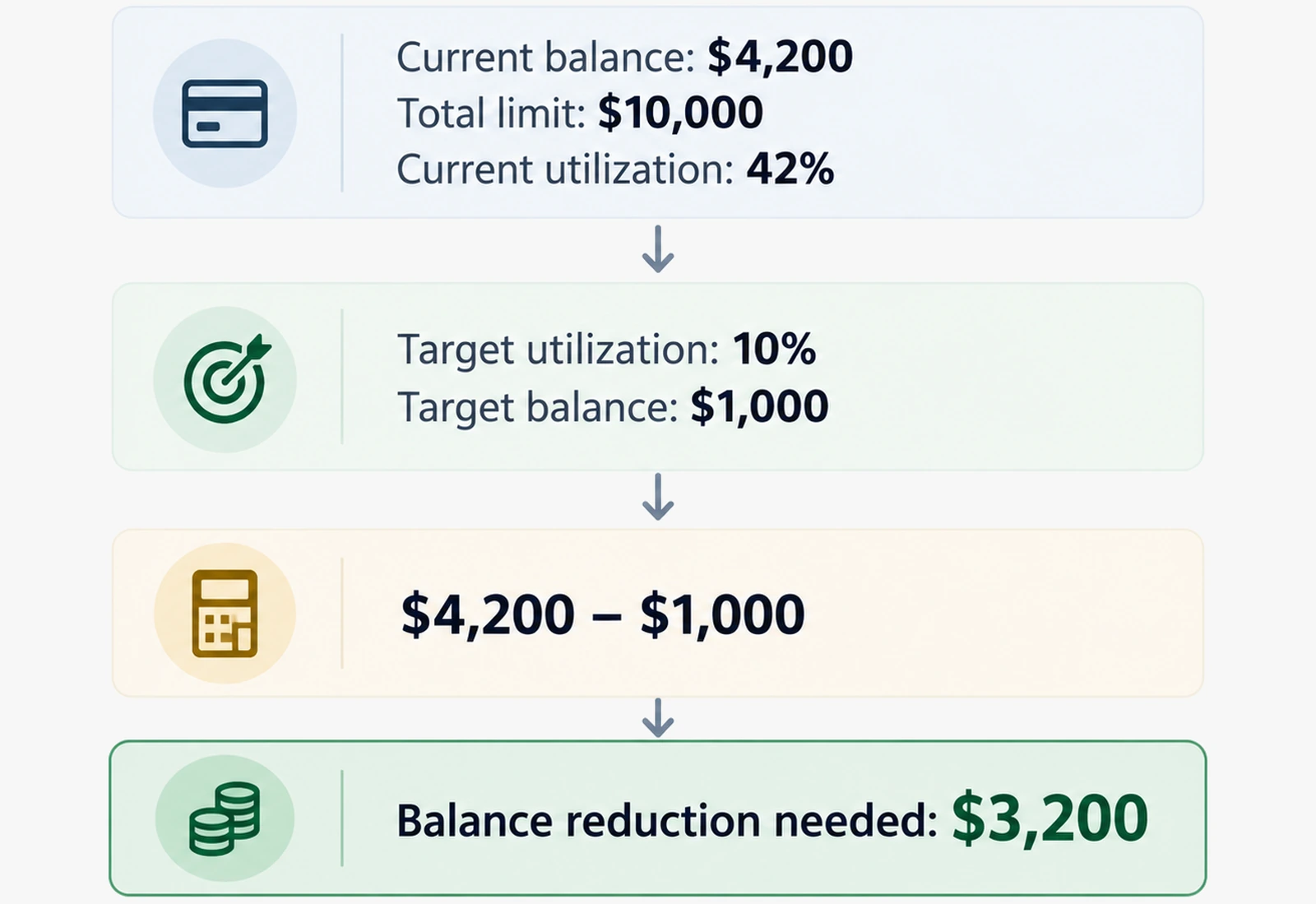
This calculation tells you what balance corresponds to a target percentage. It does not tell you whether paying that amount is the right financial decision. If reaching the target would require missing essential bills, draining emergency savings, or borrowing elsewhere at a high cost, choose a balance reduction that fits your actual finances.
Overall vs. per-card credit utilization: why both matter
Use the per-card and overall utilization comparison to calculate both figures from the same accounts. The overall figure is weighted by each card’s credit limit, not a simple average of percentages.
A low overall ratio can hide a heavily used individual card. FICO says utilization can be considered both across revolving accounts and on specific accounts.
| Account | Reported balance | Limit | Utilization |
|---|---|---|---|
| Card A | $1,800 | $2,000 | 90% |
| Card B | $0 | $8,000 | 0% |
| Overall | $1,800 | $10,000 | 18% |
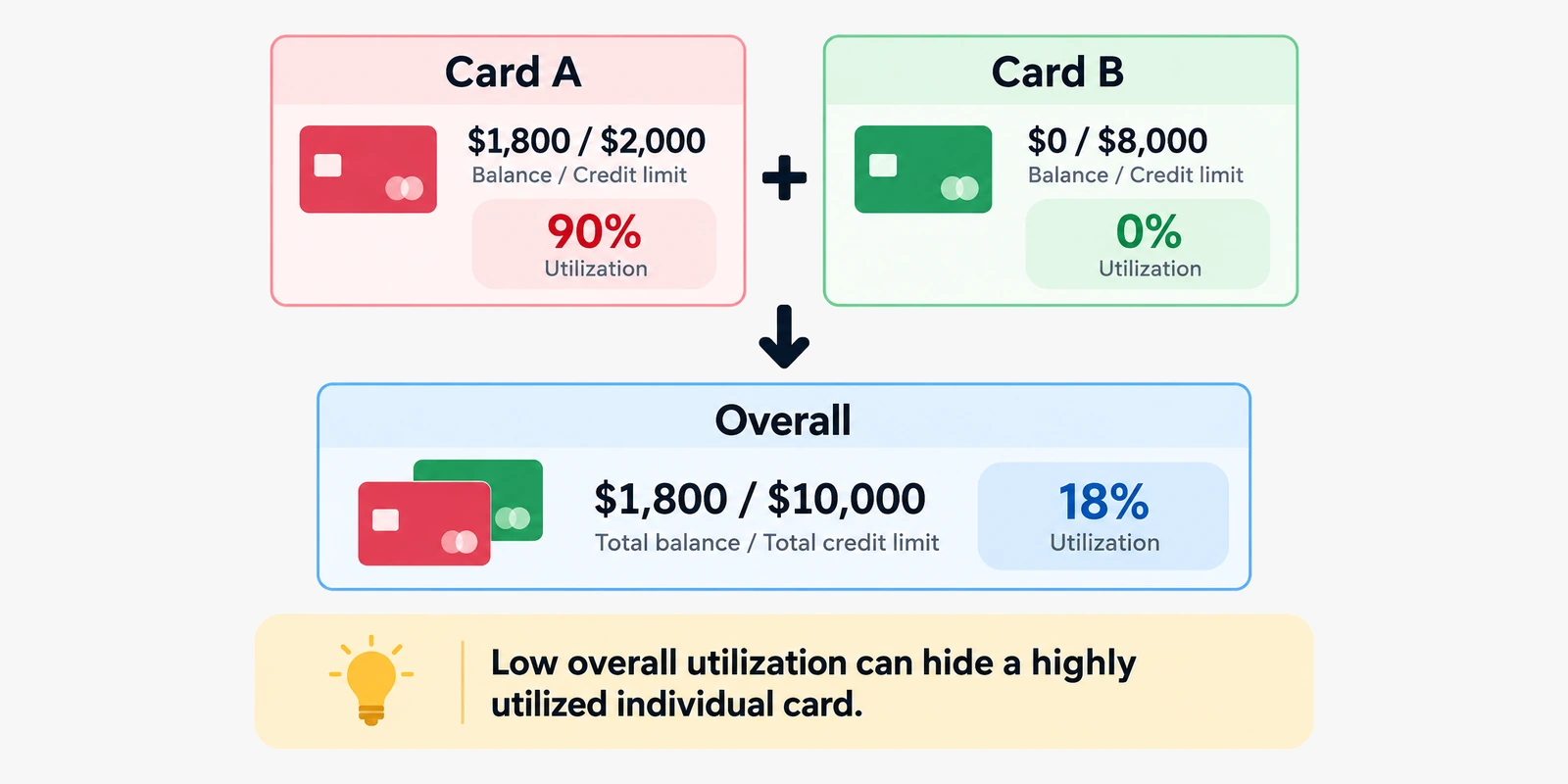
In this example, the overall ratio is only 18%, but Card A is at 90%. Check both numbers. For a deeper explanation of the calculation and which accounts count, read what credit utilization is and how it affects your credit score.
What should you do based on your utilization?
Use this order before making a payment solely to change utilization:
- Check your overall ratio. Use the balances and limits reported.
- Check each card separately. Look for a card using more of its own limit.
- Choose a realistic target. Single digits can be reasonable, but they are not required.
- Calculate the target balance. Use the formula above or the calculator.
- Protect essential cash first. Do not miss bills or drain emergency savings just to lower utilization.
If utilization is already low, another credit factor may deserve more attention.
Which balance counts toward your credit utilization?
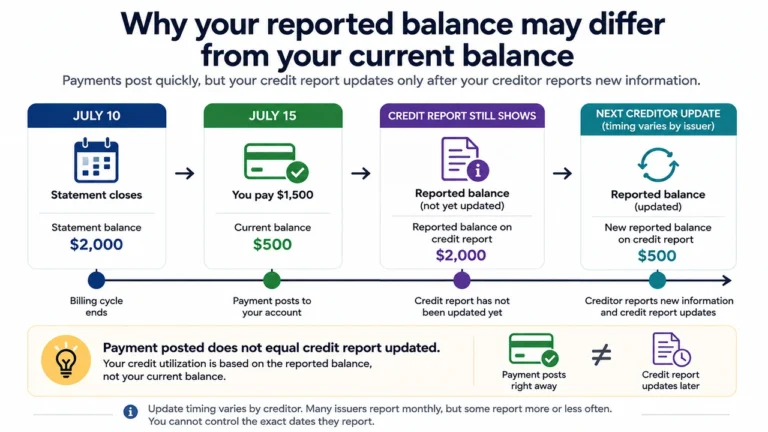
For credit-scoring purposes, the important number is generally the balance that has been reported to the credit bureau, not necessarily the live balance you see in your card app at this moment. That distinction matters if you recently made a payment, made new purchases, or are checking your ratio in the middle of a billing cycle.
For example, your card app might show a current balance of $300 after a payment, while your credit report still shows the previously reported $1,500 balance. Until the issuer sends an updated balance and the credit report changes, a score calculated from that report may still reflect the older information.
When should you pay to lower reported utilization?
Issuers commonly report the statement balance, but schedules vary. FICO explains why your report can show a balance even when you pay in full. An optional payment before the balance is recorded may lower reported utilization.
- Cover the payment already due. Pay at least the required minimum on time. Paying the full statement balance by the due date generally avoids interest on purchases when your purchase grace period applies.
- Ask which balance date your issuer reports. Leave time for a payment to post; scheduling it on closing day may be too late.
- Confirm the update. A payment in your card app does not instantly replace the balance on your credit report.
See statement date vs. due date for a two-date payment plan. An extra payment to manage utilization must not replace a bill payment already due.
This article focuses on the percentage you should aim for. For the mechanics of statement balances, reported balances, and calculation details, see what credit utilization is and how it works.
Will lowering credit utilization increase your credit score?
Lowering reported utilization can help credit scores, particularly when utilization is high, but it does not guarantee an increase or a specific number of points. Your actual score response also depends on payment history, account age, recent credit activity, and other information in the credit file used by the scoring model.
If your total limit is $10,000 and balances fall from $5,000 to $1,000, utilization drops from 50% to 10%. You can say confidently that utilization improved. You cannot say that the score will rise by 40 points—or any other predetermined amount.
Also remember that the lower balance must reach the credit report used for the score. If you recently paid a card down, see how long a credit card payoff may take to show in your score.
What if utilization is low but your score is not increasing?
Low utilization does not guarantee a higher score. If your ratio is already low, another part of your credit file may matter more, such as a late payment, recent account activity, account age, or inaccurate information. Before trying to move from 8% to 5%, confirm that utilization is actually the problem.
For a broader diagnosis, read why your credit score may not be increasing and how to track whether your credit is improving.
Frequently asked questions
Is 10% credit utilization good?
Ten percent is low utilization. FICO says generally lower is better and that keeping utilization below 10%, together with paying bills on time, can help build and maintain a good FICO Score. Ten percent still does not guarantee a particular score.
Is 30% credit utilization bad?
Not automatically. FICO says its data does not support treating 30% as a hard threshold. Think of 30% as a commonly repeated guideline rather than a pass-or-fail line.
Is 50% credit utilization bad?
Fifty percent means half of available revolving credit is being reported as used. That is substantially higher than single-digit utilization, and reducing a high ratio may help the utilization portion of a credit profile. The exact score effect cannot be predicted from the percentage alone.
Is 1% utilization better than 0%?
A very small reported balance may sometimes be treated differently from having every revolving account report $0. FICO notes that 0% can prevent maximum points in the amounts-owed category. That does not make 1% a universal ideal and does not mean you should carry debt or pay interest.
Does increasing your credit limit lower utilization?
Mathematically, yes, if the reported balance stays the same. A $1,000 balance on a $5,000 limit equals 20%; the same balance on a $10,000 limit equals 10%. A higher limit does not reduce the dollars you owe. Before requesting one, check whether a credit limit increase may involve a hard inquiry.
Can one maxed-out card matter if overall utilization is low?
If a card is already at its limit, use the maxed-out credit card action plan to check pending charges, remaining minimum payments, and affordable repayment options before adding more spending.
Yes. FICO says the amounts-owed category can consider debt on individual accounts as well as the percentage of revolving credit being used. A card at or near its limit can therefore matter even when your combined utilization across all cards looks much lower. Check each card separately in addition to the overall ratio.
What credit utilization is best for an 800 credit score?
There is no published utilization percentage that guarantees an 800 credit score. Single-digit utilization may support a strong credit profile, but payment history, account age, recent credit activity, the scoring model, and the rest of your credit report also matter. Do not treat 1%, 5%, 9%, or any other percentage as an “800 score formula.”
Do installment loans count in credit utilization?
Credit utilization usually refers to revolving accounts such as credit cards. FICO also considers installment debt within the broader amounts-owed category, but installment balances are evaluated differently from revolving utilization. A mortgage or auto loan should not simply be added to your credit card limits when calculating your credit card utilization ratio.
Does credit utilization reset every month?
Not in the sense of a fixed monthly reset date for everyone. Credit reports change when lenders furnish updated account information. If a new balance is reported, the utilization used by a newly calculated score can change. The timing can differ by issuer and account.
Should you carry a credit card balance to keep utilization above 0%?
For a dated example comparing full payment with a minimum-only payment, see why carrying a balance does not build credit. It shows how the same reported balance can coexist with very different interest costs.
No. You do not need to carry an unpaid balance from one billing cycle to the next or pay interest just to show credit activity. A card can report a statement balance and you can still pay that statement balance in full by the due date. If every card reports $0, do not intentionally create interest-bearing debt simply to change the utilization percentage.
Is credit utilization the same as how much debt you owe?
No. Utilization is a ratio: the reported revolving balance compared with the available revolving credit limit. Two people can owe the same dollar amount but have very different utilization if their credit limits differ. That is why the balance alone does not tell you the utilization percentage.
Related guides
- What is credit utilization? — definition, formula, reported balances, and which accounts count.
- Credit utilization calculator — calculate overall and per-card ratios and target balances.
- Statement date vs. due date — understand when a billing cycle closes and when payment is required.
- How long after paying off a credit card will your score update?
Explore related guides on credit cards and utilization.
Sources and editorial information
Sources
- FICO: What Should My Credit Utilization Ratio Be?
- FICO: What’s in Your FICO Scores?
- Consumer Financial Protection Bureau: Credit reports and scores
- Experian: What Is the Best Credit Utilization Ratio?
- Experian: What Is a Credit Utilization Rate?
Written by: Claire Bennett
Sources checked: October 4, 2026. This update does not represent an independent professional credit review.
Financial disclaimer: This article is for educational purposes only and is not individualized financial, legal, or credit advice. Credit scores can vary based on the scoring model used and the information in your individual credit file. No specific credit utilization percentage, payment amount, or balance reduction guarantees a particular credit score or score increase.