In this guide
- Reported balance or carried debt? Find your situation
- What does carrying a balance actually mean?
- Why your credit report can show a balance after you pay in full
- Carry a balance vs. pay in full: what changes?
- Is a small reported balance better than zero?
- Check your statement before changing your payment
- What if you cannot pay the full balance?
- Frequently asked questions
- Sources and editorial review
No. You do not need to carry a credit card balance past its payment due date or pay interest to build credit. A reported balance and an unpaid bill are different things.
Paid your $240 bill, but your card app still shows $90? That can be a newer purchase, not a missed payment. Follow the $240 statement example, then use the checklist below to identify what remains due on your own bill and what to check before paying.
FICO confirms that carrying debt is not necessary to build credit. Payment history and reported utilization are what matter here.
Reported balance or carried debt? Find your situation
Open the situation that matches your statement or credit report to find the relevant dates, amounts, and next step.
My credit report shows a balance, but I paid in full
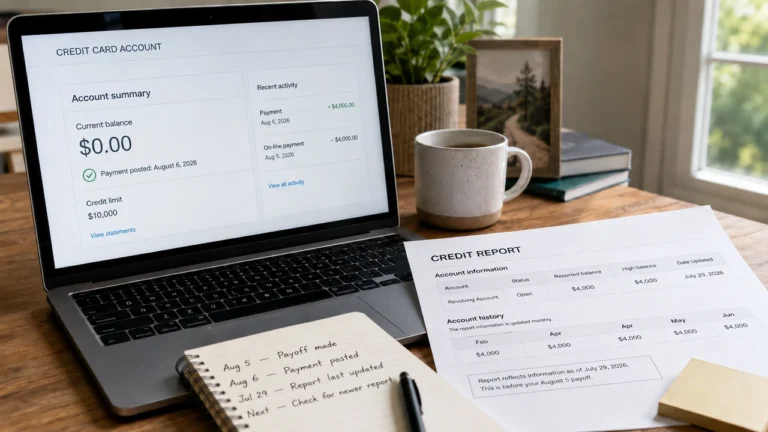
That can be normal. The issuer may have reported your statement balance before your payment posted. Check the account’s last-reported date rather than assuming you paid interest. See why a paid card may still show a reported balance.
My card app still shows a balance after I paid my bill
New purchases made after the statement closed can remain in your current balance. Check the amount still due on the last statement, its due date, and whether your grace period applies. Compare the three kinds of card balances.
I paid only the minimum amount due
Paying the required minimum on time can avoid a missed minimum payment, but it usually does not pay your statement in full. Interest may apply, and your purchase grace period may be affected. Review the pay-in-full versus minimum-payment example.
What does carrying a balance actually mean?
In this guide, carrying a balance means leaving part of a statement’s balance unpaid after its due date. Merely owing money during a billing cycle is different. A purchase can sit on your account for several weeks before the bill for it is due.
| Balance | Where to find it | What it answers |
|---|---|---|
| Statement balance | The bill issued when a billing cycle ends | What was owed when that statement closed? |
| Current balance | Your card account’s current activity screen | What is currently posted, including newer purchases and payments? |
| Reported balance | The card entry on a credit report | What balance did the issuer last furnish to that bureau? |
The unpaid portion of the statement can shrink after a payment even though the original statement remains a fixed record. If your app is unclear, ask how much remains to pay that particular bill in full.
Why your credit report can show a balance after you pay in full
myFICO explains that issuers commonly report the statement balance. If that snapshot is sent before your payment, it can remain on the report until updated information arrives. Reporting practices vary; the due date is not a universal reporting date.
Read the account’s update date alongside its balance. A score calculated from an older report cannot reflect a payment that has not reached that report. If you have already paid, use our credit card payoff and score-update checklist to identify the stage you are waiting for.
Paid $240, still see $90: a statement example
Hypothetical example: A card has a $3,000 limit and an active purchase grace period. There is no previous carried debt, cash advance, promotional balance, fee, or other activity beyond the transactions below. Assume the issuer reports the closing balance on October 1 and sends no further update before October 26.
| Date | Account activity | What it means |
|---|---|---|
| October 1 | Statement closes at $240; payment is due October 26. The issuer reports $240. | $240 ÷ $3,000 × 100 = 8% reported utilization. |
| October 5 | A new $90 purchase posts. Current balance becomes $330. | The $90 belongs to the next statement cycle. |
| October 24 | A $240 payment posts. Current balance becomes $90. | The October 1 statement is paid in full before its deadline. |
| October 26 | The report still shows the earlier $240 snapshot. | The reported balance and the unpaid amount of that bill are different numbers. |
Under these assumptions and the card’s grace-period terms, the $240 statement purchases do not incur interest. The newer $90 is still owed but is not an unpaid remainder of the October 1 bill. The $90 purchase will appear on the next statement, which will show its payment due date.
Try your own numbers: Open our credit utilization calculator and use the balance and credit limit shown on your credit report. It calculates a percentage, not a predicted score change. The example’s 8% is not a spending target; see how credit utilization is calculated for the formula.
You paid the bill. Why does the app still show $90?
After the October 24 payment in this example, all three numbers can be correct:
Left to pay on the October 1 statement
$0
The $240 statement has been paid in full.
Current balance in the card app
$90
The newer purchase belongs to the next bill.
Balance still on the credit report
$240
An earlier snapshot, equal to 8% of the limit.
Carry a balance vs. pay in full: what changes?
Now change only the payment in that example. Suppose the required minimum is $30 and you pay $30 instead of $240 by October 26. You have covered the minimum, but $210 of the statement remains unpaid. With the newer $90 purchase, the account has $300 in principal outstanding before any interest or other adjustments.
Both versions can initially show the same $240 reported snapshot. Leaving $210 unpaid does not make that snapshot more useful. It creates a repayment obligation and may change how interest applies.
The CFPB explains the purchase grace period: cards are not required to offer one, and failing to pay in full can cause you to lose it. Interest can then apply to the unpaid balance and to new purchases from their transaction dates. Cash advances generally follow different rules.
Already paying interest? Check how to preserve or regain your grace period; one full payment may not immediately restore interest-free purchases.
What unnecessary interest can cost
For a separate hypothetical estimate, assume $1,000 remains subject to a 24% APR for 30 days. Using a 365-day year and no compounding, payments, fees, or new purchases:
$1,000 × 0.24 ÷ 365 × 30 = approximately $19.73.
This is not a forecast of a particular statement. The CFPB’s interest-calculation guidance explains that many issuers use daily balances. Payment timing and the agreement’s method affect the actual charge. There is no need to incur that cost merely to establish that you used credit.
Is a small reported balance better than zero?
FICO says very low reported revolving utilization can score more favorably than every revolving account reporting $0. A score may therefore move when the reported balances change, even if paying off the debt was financially useful.
This is a distinction about reported information, not an instruction to leave a statement unpaid. You can have ordinary purchases reported and then pay the bill in full. You do not need to manufacture spending, keep exactly $1 unpaid, or pay interest to meet a supposed scoring rule. If you rarely use a card, see what credit card inactivity can mean for your credit score and how to monitor it without taking on unnecessary debt.
If you are choosing a utilization target, our guide to a good credit utilization ratio covers the percentages and their limits. No particular reported balance guarantees an approval or score.
Check your statement before changing your payment
- Find the bill’s due date and remaining minimum. Protect the required payment first.
- Find the remaining statement amount. Separate it from purchases made after the statement closed.
- Check whether purchase interest is already accruing. Read the interest section and ask whether the grace period is active.
- Confirm the payment setting. Minimum-payment autopay and statement-balance autopay accomplish different things. Check the scheduled amount and bank funds.
- Verify the payment posted. A scheduled or returned payment is not a completed payment.
- Use a credit report for reporting questions. Compare the balance and account update date rather than treating your score dashboard as a bill.
If you cannot reconcile the amounts, ask the issuer:
“How much remains to pay my latest statement in full by its due date? Does my purchase grace period currently apply? Which part of my current balance belongs to newer purchases, and will any accrued interest appear later?”
What if you cannot pay the full balance?
Carrying debt because money is tight is different from choosing it as a credit-building strategy. Cover the required minimum on time if you can, protect essentials, and make an affordable repayment plan. Interest and utilization still need attention, but an arbitrary score target should not decide which essential bills you can pay.
If even the minimum is unmanageable, contact the issuer promptly. Explain the shortfall, what you can afford, and how long you need help. Confirm any agreement’s terms rather than assuming the conversation changes the existing deadline.
Frequently asked questions
Should you leave $10 on your credit card?
There is no universal need to do so. If $10 is left unpaid from a statement after its due date, it can affect interest treatment. If it is a new purchase not yet due, that is a different situation. Identify which balance you are looking at.
Does carrying a balance at 0% APR help your score?
A genuine 0% introductory APR can reduce interest on eligible purchases or balance transfers, but it does not give you extra credit-score points merely for carrying debt. The reported balance still counts toward credit utilization, and you must keep making at least the required minimum payments on time. Check which transactions qualify, when the offer ends, and the APR that applies afterward. A 0% balance-transfer offer may not protect new purchases from interest; see the CFPB explanation of purchase interest during promotional transfers. A deferred-interest offer is different from a true 0% APR promotion and can charge previously deferred interest if its conditions are not met.
Does paying in full mean paying the current balance?
For ordinary purchases with an active grace period, the relevant full-payment amount is generally the statement balance remaining due. The current balance can include newer purchases. Special payment plans, carried debt, cash advances, and promotional balances require checking the actual terms.
Sources and editorial review
Sources verified October 13, 2026. The following first-party guidance supports the main points in this article:
- myFICO: Carrying credit card debt does not improve FICO Scores — explains why paying interest is not necessary to build credit.
- myFICO: Why a paid-in-full card can still show a reported balance — explains the reporting snapshot used in the statement example.
- CFPB: Credit card purchase grace periods — explains when paying a statement in full can avoid purchase interest and when that protection can be lost.
- CFPB: Credit card interest calculations — describes daily-interest methods; actual charges depend on the card agreement and daily balances.
- myFICO: How revolving accounts affect FICO Scores — explains reported utilization, including why a small reported balance may score differently from all cards reporting zero.
- CFPB: Interest on purchases after a promotional balance transfer — supports the caution about 0% offers and purchase interest.
Example methodology: The $240 statement, $90 new purchase, 8% utilization, and $19.73 interest estimate are hypothetical examples calculated for this guide, not case studies reported by FICO or the CFPB. They illustrate arithmetic and billing dates, not expected score changes or actual interest charges. The content was compared with the sources above; it was not independently reviewed by a licensed financial professional.
Educational information only. This article provides general U.S. consumer-credit information, not individualized financial or legal advice. Your cardholder agreement, billing statements, and payment history determine which interest and payment rules apply to your account.