In this guide
- Transfer still pending? Start here
- How long does a balance transfer take at different banks?
- Track the request, the transfer and the credited payment separately
- What to do while a balance transfer is pending
- Why is your balance transfer taking so long?
- What to check after the transfer arrives
- Common questions about transfer delays
- Save this balance transfer checklist
- Sources and review
A credit card balance transfer can take several days to a few weeks, and a new-account waiting period can make it longer. There is no universal deadline. The receiving issuer must approve and send the transfer, and the original creditor must credit the payment.
Keep making required payments on the original card until you confirm the transfer has arrived. A request confirmation, approval or new balance on the receiving card is not enough to prove that the old card’s current payment requirement has been met.
How long does a balance transfer take at different banks?
These are the issuers’ published explanations checked on October 13, 2026, not a promise for an individual request. Follow the estimate and conditions attached to your own offer.
| Receiving issuer | Published timing | Important qualification |
|---|---|---|
| Capital One | Its product FAQ says sending and posting to Capital One takes 4–6 days. A mailed check can take up to 15 business days to reach the creditor. | Posting on the receiving card and arrival at the original creditor are different stages. |
| Citi | Existing accounts: up to 10 days, depending on the disbursement method. New accounts: processing starts 14 days after opening, then can take up to 10 days. | The new-account waiting period comes before processing; it is not included in the 10-day estimate. |
| Bank of America | Most electronic transfers finish within 2–4 business days. Checks take longer. | For new accounts, processing starts at least 14 days after account approval. |
| Chase | Most transfers are processed within a week, but some can take up to 21 days. | Timing also depends on the original creditor processing the payment. Confirm it has posted to the old account before treating that payment obligation as met. |
Capital One’s help-center page separately says an approved request is processed immediately, while reaching the other creditor can take about 15 business days. Because these pages describe different stages, ask which estimate applies to your request. Do not add their timelines together automatically.
When a bank specifies business days, weekends and banking holidays can extend the elapsed time. When its wording only says days, do not silently convert that figure into business days. Ask the issuer to give you an expected arrival date.
If you are still choosing a payment method, first read whether you can pay a credit card with another credit card. A balance transfer and a cash advance follow different rules.
Track the request, the transfer and the credited payment separately
Use a simple three-stage record:
- Requested: Save the submission date, amount and confirmation screen. Record any reference number provided.
- Approved and sent: Check whether processing has begun, the amount actually sent, the sending date and whether delivery is electronic or by check.
- Credited to the original account: Match the payment amount and posting date in the old card’s transaction history. Check the remaining balance and payment still due.
These entries answer different questions. “Approved” describes a decision; “sent” describes a transfer step; a matching credited payment tells you the original account received it. The exact labels vary by issuer.
Citi’s FAQ directs cardholders to Balance Transfers under Payments & Transfers, then “Track the status.” Requests should appear on its status page within one business day. Bank of America provides transfer history through Online Banking or its mobile app. Use the official app or website, or the number printed on your card.

What to do while a balance transfer is pending
Protect the original card’s due date first. The issuers’ guidance above tells you to continue required payments until the transfer is completed or received. Your statement date and payment due date are separate from the transfer processing clock.
Here is a hypothetical timeline, not a bank’s promised turnaround:
- Day 1: You request a $2,000 transfer.
- Day 5: The original card’s $60 minimum is due. If the transfer has not arrived and the $60 is still due, pay at least that amount by the issuer’s cutoff, or contact it before the deadline if you cannot pay.
- Day 9: The original issuer credits the transfer. Check the resulting balance, including any separate payment you made.
Do not assume the transfer amount automatically decreases because you made a separate payment. If the final payments exceed what you owe, check the account and follow the steps for an overpaid credit card balance.
Review scheduled payments before changing them. Whether a manual payment or transferred payment changes an upcoming automatic debit depends on the issuer’s rules and timing. Our credit card autopay guide covers the checks to make. Do not cancel the old card’s payment setup solely because a transfer request was accepted.
If you cannot afford the required payment, contact the issuer promptly about assistance. A pending transfer is not a payment arrangement.
Does the old card keep charging interest while you wait?
If the original balance is already accruing interest, requesting a transfer does not stop that interest. The payment has to reach the original account. The CFPB explains daily periodic interest rates; the issuer’s calculation method determines the actual charge.
Separate hypothetical example: A $3,000 interest-bearing balance at 24% APR remains unpaid for 14 additional days before the transfer arrives. A simple estimate using a 365-day year is $3,000 × 0.24 ÷ 365 × 14 = $27.62.
This illustration excludes compounding, fees, purchases and intervening payments; some issuers use a 360-day divisor. It is not a payoff quote or a reason to skip a required payment. Check the remaining balance after the transfer posts.
Can a delay reduce your time at 0% APR?
Yes, if your offer’s promotional period starts before the transfer arrives. Chase describes introductory APR periods measured from account opening. Your own offer controls; do not assume the full advertised period starts when the old card receives payment.
Record three separate dates from the offer and your statements:
- The original card’s next payment due date.
- The deadline to request or complete an eligible transfer, as specified in the offer, including any reduced-fee deadline.
- The date the promotional APR ends on the receiving card.
If a transfer deadline is close, ask the issuer which event must happen by that date and how your pending request will be treated. Ask for confirmation of the applicable APR and fee instead of assuming a delay extends the offer.
Why is your balance transfer taking so long?
Start with the stage where progress stopped. Possible explanations to investigate include a new-account waiting period, delivery by check, a mismatch in creditor details, insufficient eligible capacity or a declined request. “Pending” alone does not identify the cause.
For example, Capital One requires the other creditor’s name, account number and payment address. Verify those details against your statement. Citi notes that available credit and other eligibility factors can affect approval. Check the actual result instead of assuming every delay is ordinary processing.
Check whether the two accounts are eligible for a transfer. Different card names do not necessarily mean different issuers. Chase does not allow balance transfers to pay credit cards or loans issued by JPMorgan Chase Bank, N.A., or its affiliates. Capital One prohibits transfers between its own accounts and between Capital One and Discover accounts, because Discover is now part of Capital One. If your request involves related issuers, confirm eligibility and the actual request status; waiting longer will not resolve an ineligible transfer.
If the receiving issuer has not sent the funds
Ask whether the request is approved, whether anything is missing, when any waiting period ends and what arrival estimate applies. Do not submit a duplicate transfer just to see whether it goes faster.
If the funds were sent but the old card shows no payment
Ask the sending issuer for the transmission date, method, amount and any trace or check information it can provide. Give those details to the original creditor and ask whether it can locate the payment. Request a case number and a specific follow-up date.
A useful call script is: “I requested a transfer of [amount] on [date]. The sending account says [status], but the original account has not credited it. Has the payment been sent, how was it sent, and what information can you provide to help the other creditor locate it?”
Contact the issuer when its quoted arrival window has passed, or sooner if the status shows a problem or a payment deadline is approaching. There is no single day count that works for every bank and delivery method.
If calls do not resolve a missing payment
If a statement omits a payment that should have been credited, follow the issuer’s billing-error instructions. For a covered billing error, Regulation Z requires the issuer to receive your written notice no later than 60 days after it sent the first statement that should have reflected the payment. Use the billing-inquiries address on the statement, which may differ from the payment address. Include your account identification, the missing amount and date, and why you believe it is an error; retain a copy and delivery record. A transfer request that has not been sent is not proof of a billing error.
If contacting the companies does not resolve the problem, you can submit a credit card complaint to the CFPB. Include the transfer amount, request and sending dates, statements from both accounts, trace details, case numbers and the correction you want. A complaint does not replace a timely billing-error notice. Keep undisputed payments current.
What to check after the transfer arrives
- Match the amount sent with the amount credited. Investigate any partial transfer or discrepancy.
- Check the original account for purchases, fees or interest that appears after a payoff.
- Confirm the receiving card’s new balance, transfer fee, minimum payment, due date and promotional end date.
- Set a repayment budget that fits the actual time left in the promotion.
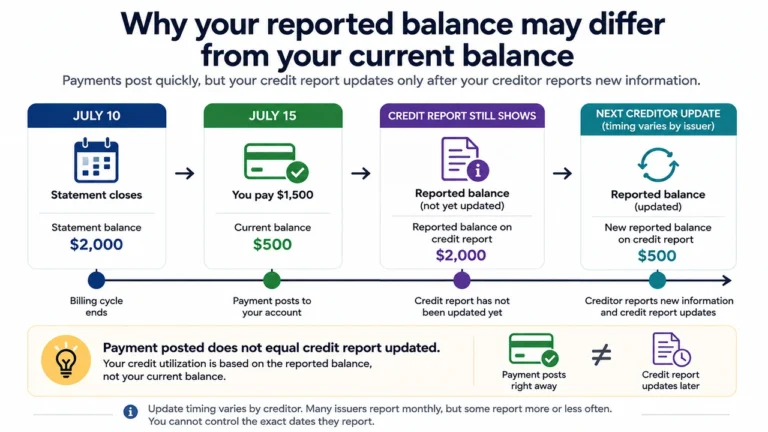
If a credit report still displays an old balance, check the card accounts directly before deciding the transfer failed. Transfer completion and credit reporting are separate questions; see how balance transfers affect your credit profile.
Common questions about transfer delays
Can a balance transfer be completed the same day?
Do not plan around same-day arrival unless your issuer specifically confirms it for your request. Immediate processing does not mean immediate receipt by the other creditor.
Can you cancel a pending balance transfer?
Ask the receiving issuer before assuming cancellation is possible. Citi allows changes or cancellation during its 14-day new-account waiting period. That does not establish the rule for another issuer or a payment already sent.
Should you wait for your next statement to check?
No. Check current transaction history and the transfer status. Then review the next statement for the remaining balance, interest and scheduled payment requirements.
Explore related guides on credit cards and utilization.
Save this balance transfer checklist
Keep this six-step check handy while your transfer is in progress.
- Save the request: Date, amount and confirmation number.
- Record both deadlines: Expected arrival and the old card’s next payment due date.
- Keep payments current: Confirm receipt on the original account before treating its payment requirement as met.
- Trace a delay: Get the sending date, delivery method and trace details; follow up with both issuers.
- Reconcile the old account: Match the credited amount and check remaining interest, fees and scheduled payments.
- Check the new account: Transfer fee, minimum payment, due date and promotional APR end date.
Sources and review
Checked October 13, 2026. Issuer guidance is linked in the table and beside the relevant statements. The nine-day payment scenario, interest estimate, tracking checklist and call script are educational examples created for this guide, not bank service guarantees or individual account results.
- Capital One: Balance transfer product FAQ and Help Center transfer guidance — processing stages and issuer restrictions.
- Citi: Balance transfer FAQ — new-account waiting period, processing, cancellation and status checks.
- Bank of America: Credit card account management FAQ — electronic transfers, checks and new accounts.
- Chase: Balance transfer FAQ and Introductory APR explanation — transfer timing, restrictions and promotional periods.
- CFPB: Daily periodic interest rates — calculation methods and limitations.
- Regulation Z, § 1026.13, CFPB: Fixing credit card billing mistakes and Submitting a complaint — separate ways to address an unresolved problem.
- CFPB: When you cannot pay your credit card bill — contacting the issuer about assistance.
Read our editorial policy and source standards. Terms can change. This guide provides educational information for U.S. readers, not individualized financial or legal advice.