In this guide
- The direct answer
- What per-card and overall utilization mean
- Why one number cannot replace the other
- Illustrative example: three cards, two useful views
- Use statement timing for the math that is actually reported
- How to prioritize payments without harming your budget
- Special cases that can make utilization confusing
- Frequently asked questions
- Use both numbers, then make a sustainable plan
- Your next step
- Sources
The direct answer
Both per-card and overall credit utilization can matter. Credit scoring models may evaluate the balance reported on each revolving account relative to that account’s limit, while also evaluating reported revolving balances across eligible accounts compared with total available limits. Neither measure has a public, universal weighting or a published cutoff. In practice, a high reported utilization percentage on one card can matter even when your overall ratio is modest. If the same accounts are included, overall utilization is a credit-limit-weighted average: it cannot exceed the highest individual ratio. Which has more effect varies by scoring model and the information in your credit file.
For most people, the useful approach is to monitor both numbers: avoid allowing a single card to report an unusually large share of its limit when practical, and keep the balances reported across cards manageable relative to their combined limits. That is different from carrying a balance to build credit. Paying a statement balance in full by its due date can avoid interest on purchases when your card agreement provides a grace period.
What per-card and overall utilization mean
Credit utilization is generally the percentage of available revolving credit that appears to be in use. Revolving accounts commonly include credit cards and certain lines of credit. It is not the same thing as total debt, your monthly payment amount, or debt-to-income ratio. For a fuller distinction, see debt-to-income versus credit utilization.
Per-card utilization
Per-card utilization looks at each account separately. The basic calculation is:
Reported card balance ÷ credit limit × 100 = per-card utilization
If a card reports a $600 balance and has a $2,000 limit, its utilization is 30%. This number describes that card only. It does not account for unused credit on your other cards.
Overall utilization
Overall, or aggregate, utilization combines reported balances and credit limits across applicable revolving accounts:
Total reported revolving balances ÷ total revolving credit limits × 100 = overall utilization
For example, $1,000 in reported balances across cards with $10,000 in combined limits equals 10% overall utilization. The Consumer Financial Protection Bureau explains that utilization compares the credit you use with the total credit available to you. Its explanation is available through the CFPB’s credit utilization guidance.
Why one number cannot replace the other
It is tempting to focus only on the overall percentage because it seems to summarize your available credit. But aggregate utilization can hide a concentrated balance. Someone with several cards may have plenty of unused credit in total while one account reports close to its limit.
Overall utilization is calculated from dollar totals, not by averaging the percentages shown for each card. A $900 balance on a $1,000 limit and a $100 balance on a $9,000 limit equal 10% overall utilization, not the simple average of 90% and about 1.1%. FICO explains that both overall utilization and high utilization on individual revolving accounts can matter. Keep a list of the same included accounts when comparing the two measures.
💡 Important: A commonly repeated percentage is not a scoring target or a cliff. Utilization is not publicly mapped to one score outcome, and a change may affect people differently depending on their account history, limits, balances, score model, and the rest of the credit report.
Illustrative example: three cards, two useful views
This example uses balances that appear on card statements or are otherwise reported to credit bureaus. It is illustrative only; it is not a prediction of a score change.
The total reported balance is $1,000. The total credit limit is $10,000. Overall utilization is therefore $1,000 ÷ $10,000 × 100, or 10%. The aggregate figure is modest, but Card A still reports a very high percentage of its own limit. This is why per-card versus overall credit utilization is not an either-or question: both views describe different parts of the same report.
Use statement timing for the math that is actually reported
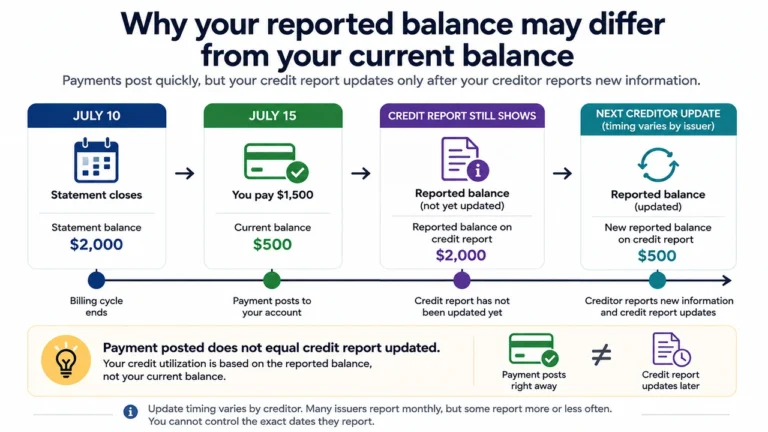
For utilization purposes, the balance you see at the moment you make a purchase is not always the balance a credit bureau receives. Many card issuers report information around the statement closing date, though reporting practices can differ. Your due date is usually the deadline to make at least the required payment; it is not necessarily the date used for the balance that gets reported.
Understanding that distinction can help you plan without overcomplicating your finances. Read credit card statement date versus due date for a practical explanation. If you want a lower reported balance for a particular cycle, making a payment before the statement closes may change what appears on that statement. It does not erase a purchase, eliminate interest already owed, or guarantee how a score will respond.
Do not confuse reported revolving balances with all debt. A mortgage, auto loan, student loan, or personal loan may affect your credit profile, but those installment balances are not normally divided by credit card limits to calculate revolving utilization. Your income also is not part of this calculation.
How to prioritize payments without harming your budget
If you have money available beyond required bills, compare both utilization views before deciding where an extra payment will do the most. A card with a high reported percentage may be a sensible place to focus, especially when another card’s unused limit makes your total percentage look lower than the individual account picture suggests. Interest rates, promotional terms, minimum payments, and cash flow still matter.
Prioritization checklist
- List each revolving account’s reported balance, limit, statement closing date, APR, and payment due date.
- Calculate every per-card percentage using the reported balance divided by that card’s limit.
- Add reported balances and limits separately, then calculate overall utilization from the two totals.
- Pay at least the required amount on every account by its due date whenever possible.
- Before sending extra money, protect housing, food, utilities, insurance, transportation, and a reasonable emergency cushion.
- Direct any affordable extra payment according to your goals, including reducing high-interest debt and avoiding unusually high reported balances on individual cards.
- Check the next statements and credit reports for accuracy rather than assuming immediate or identical reporting everywhere.
Special cases that can make utilization confusing
A card with no preset spending limit deserves care. Some charge cards and flexible-limit cards do not operate like a traditional credit card with a fixed reported limit. The amount you can spend may vary, and a credit report may show no limit, a high balance, or another value depending on how the issuer furnishes data. That means a simple balance divided by limit calculation may not be meaningful for that account.
Do not invent a limit by using the amount you think you can charge, your last statement balance, or a spending-power estimate in an app. Instead, look at the actual information in your credit reports and statements. You can request free reports through AnnualCreditReport.com, the authorized source for free credit reports under federal law.
Another edge case is a recent credit-limit change. A lower limit can raise utilization even if the balance stays the same, while a higher limit can lower the ratio. A closed card may also change aggregate available credit. Removing yourself as an authorized user can similarly change which balances and limits count if that account was included in the scoring model. Opening or closing accounts solely to manipulate a percentage can involve tradeoffs beyond utilization, including account age, inquiries, fees, and spending behavior.
Frequently asked questions
Is it better to spread a balance across cards?
There is no universal answer. Spreading a balance can lower the percentage on one account but may increase the number of cards reporting balances. Keeping a balance on one card can concentrate utilization. Consider the total cost, payment due dates, and both utilization measures rather than relying on a one-size-fits-all rule.
Should every card report a zero balance?
There is no need to carry interest-bearing debt for the purpose of making a card report a balance. A zero reported balance can simply mean you paid before the reporting point. Whether reported balances affect a particular score depends on the score model and your broader credit file.
How often should I check utilization?
Check when you are actively paying down revolving debt, before a major credit application, after a limit change, or when reviewing statements. Otherwise, periodic reviews may be enough. Avoid making frequent transfers or payments that create overdrafts, skipped essentials, or unnecessary financial stress.
Use both numbers, then make a sustainable plan
Calculate individual and overall utilization from reported balances, then prioritize on-time payments and an affordable payoff strategy.
Your next step
Per-card utilization and overall utilization can both matter because they answer different questions. One shows whether a particular revolving account reports a large balance compared with its own limit. The other shows reported revolving balances compared with all available revolving credit. Use reported figures, not just current app balances, and remember that score effects vary by model and credit file. For more context, review what a good credit utilization ratio means.
Explore related guides on credit cards and utilization.
Sources
- CFPB financial terms glossary: credit utilization ratio
- myFICO: What is in your credit score?
- AnnualCreditReport.com: Request your free credit reports
Sources checked October 7, 2026.
Claire Bennett is an editorial name, as explained on the author page. No independent expert review is claimed.
Educational information only; not legal, tax, or financial advice.